Visit msnbc.com for breaking news, world news, and news about the economy
Showing posts with label faubourg treme. Show all posts
Showing posts with label faubourg treme. Show all posts
Friday, September 10, 2010

Friday, June 12, 2009
NolaFunk Lagniappe
 Allen Toussaint's Keys To New Orleans
Web-Only Concert Pick: Allen Toussaint Performs 'Freedom For The Stallion'

Allen Toussaint keeps the New Orleans jazz-piano tradition alive in a concert from the Kennedy Center. New Orleans is not only the cradle of jazz. It's also the birthplace of great jazz piano, dating back to the early 1900s, when Jelly Roll Morton tickled the ivories. Hear three pianists who are keeping upholding that great tradition — Allen Toussaint, Henry Butler and Jon Cleary — onstage at the Kennedy Center in Washington, D.C., with Keys to New Orleans.
Marva Wright: Sharing the Joy of the Blues

Marva Wright’s boisterous vocals have established her as the clearly acknowledged “Blues Queen of New Orleans.” Marva started singing in the church at the age of nine, with her mother providing the accompaniment. Gospel legend Mahalia Jackson was a friend of the family, and Marva put her talents on display primarily for the congregation for decades. It was in church that she learned an early lesson with regard to her singing that she has carried throughout her career.
“When I played my first solo, ‘Just a Closer Walk with Thee,’ one of the deacons in the church was on the front bench,” she recalled. “He told me that I opened my mouth wide, but nothing was coming out of it. From that day, I vowed that I would always sing loudly.”
The Masterful Allen Toussaint & The Bright Mississippi
“Stately” is an adjective I rarely use to describe an album, but it fits Allen Toussaint’s new album, The Bright Mississippi, like a glove. The Bright Mississippi is a special album, demanding multiple listens to truly get the tapestry of American music – Ellington inspired jazz, r&b, Creole, ragtime – that it weaves with such effortless cool. It’s an album that contains the full experience that is life – its joys, sorrows, delights and hardships. That is to say, it's an album with soul.see also: Allen Toussaint Set For Lincoln Center Out Of Doors 8/22
Toussaint, of course, is an American Treasure; one of the masters of American R&B, a songwriter and producer who has worked with the likes of Dr. John, The Meters, Labelle, Elvis Costello, Solomon Burke, the Band and dozens of other greats. American R&B (and therefore, American music) is practically inconceivable without him.
This will be one of the best albums of the year – go out and get it. It’s not only that they don’t make albums like this anymore – it’s that no one before has ever made one quite like this.
NY Daily News: Skirting the Treme: An insider's guide to New Orleans
Rampart Street, in some ways, is the fault line of New Orleans, separating the French Quarter, filled with well-heeled tourists and spring-breakers, from the Treme, a slightly more foreboding yet just as historic and memorable district.
Skirting the Treme, and further east the Seventh Ward, St. Roch and St. Claude neighborhoods, the adventurous visitor may experience the charm and flirt with the blithe unpredictability that permeates the real New Orleans that many tourists miss.
 Community Tied By Strong Threads
The eclectic Threadhead roster features Continental Drifters alumnus Cowsill, jazz/pop/gospel singer John Boutté, singer/songwriters Paul Sanchez and Alex McMurray, genre-crossing trumpeter Shamarr Allen, jazz trombonist/vocalist Glen David Andrews, progressive brass band the New Orleans Nightcrawlers, trombonist Rick Trolsen, and bluesrocker Marc Stone. The company also recently published its first book, Pieces Of Me, collecting Sanchez's cathartically heart-wrenching, touching and funny blog entries about his rough yet rewarding journey back from the post-Hurricane Katrina trauma of losing his home and community.
Stew Called New Orleans”
Although I don’t listen to a whole lot of recorded music, when I find an album of music that I really like, I can get pretty obsessed, & right now I’ve found one that’s so good enough I have to write about it.
I should say the album “found me,” thanks to good blog friend Citizen K. who posted about it here—an excellent review that’s defintiely worth checking out— & then was kind enough to supply me with a copy. It’s called A Stew Called New Orleans (Threadhead Records), & it features the truly amazing vocals of John Boutté, along with vocals & rhythm guitar work by Paul Sanchez, trumpet by Leroy Jones, some exceptional electric guitar work by Todd Duke & bass by Peter Harris.
Michael Arnone's 20th Anniversary Crawfish Festival: New Orleans Comes to New Jersey
Each of the three stages had its own personality. The larger main stage hosted high energy acts that could play to the thousands who pulled up their lawn chairs to hear the powerful groups. A few of the ten bands on this stage included the High and Mighty Brass Band, with its Dirty Dozen/ Rebirth Brass Band stylings, and Papa Grow's Funk, which impressed the audience with its hard driving organ-fueled New Orleans sound. Day two featured Grammy-nominated blues guitarist Tab Benoit who drew thousands to stand and dance in the pit in front of the stage. The energy was palpable as Benoit moved across the stage playing flawless, high energy blues guitar.
 BackTalk with James “Sugar Boy” Crawford
Whether you call it “Jock-A-Mo” or Chock-A-Mo” or “Iko-Iko,” it’s one of the greatest of all New Orleans Carnival songs. James “Sugar Boy” Crawford, who recorded the original version in 1953, rarely performs these days, preferring to bask in the glow of his incandescent grandson Davell. “The only place I sing is in church no,” Sugar Boy confesses.
“Jock-A-Mo,” one of a select handful of truly memorable Carnival songs, has had multiple personalities over the decades. Originally recorded in 1953 by James “Sugar Boy” Crawford, it was turned into an international hit over a decade later by a trio of New Orleans teenagers, the Dixie Cups, as “Iko Iko.” Since then, the song has been covered by Willie DeVille, Dr. John, the Neville Brothers, the Bell Stars [their version was in the Academy Award-winning movie Rain Man] and Cyndi Lauper, although none have approached the magnificence of Sugar Boy’s original.
Dr. John: Goin' Back to New Orleans 
Rating: 98/100
Mac Rebennack, better known as Dr. John, is a walking, talking compendium of New Orleans music. As session cat, genial tickler of the ivories (organ keys and guitar strings too), gris-gris hoodoo-man, gargle-voiced blues shouter, worldwide rock star, and tireless proponent of all that's Easy—not to mention serious jazz pianist and master of Crescent City r&b—he has lived and largely defined the late 20th Century idea of New Orleans musician. His few solo piano albums are brilliant, and so too many of his slice-of-NOLA releases reinvigorating "funky butt" r&b. Still, in the end it's Mac at the piano that matters most as he takes the whole tradition into his hands every time he sits down at a keyboard.
Sister Gertrude MorganSister Gertrude Morgan (1900-1980) was a preacher, missionary, artist, musician, and poet who worked in New Orleans in the 1960s and '70s, notable primarily for her folk art. She was born in 1900 in Lafayette, Alabama, and moved to Columbus, Georgia at the age of eighteen. She was married to Will Morgan in 1928, but at the age of 38 heard a voice from God telling her to become a street evangelist. She left her family and husband to move to New Orleans, where she organized an orphanage with two other missionaries. God told her to begin painting in 1956 and in 1957 heard a voice telling her that she was the Bride of Christ.
Christian Scott riding superlative horn waveLike a lot of creative types, trumpeter Christian Scott is hard to stuff into a genre box. First, there's the clear sound of his horn, the one with the oddly angled bell. It's unmistakably part of a grand New Orleans tradition that reaches back to Louis Armstrong: a lone, expressive voice that projects its own personality as much as it does virtuosity. He could easily be playing gigs in the style of traditional New Orleans music or in the post- bop style practiced by another Crescent City hero, Wynton Marsalis.
But Scott prefers to push his trumpet up against walls of cinematic, rockish chords and instrumentation that reminds me more of the European trumpeter Michael Mantler than any of Scott's New Orleans brethren. Listening to his latest studio disc, "Anthem" or last year's "Live at Newport" set indicates that he absorbs a good deal of music and assimilates all of it into his own compositions and approach.
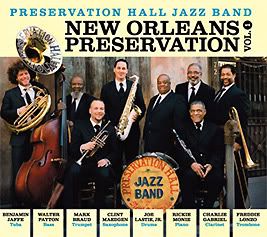
NOPV1 Reviewed by Alex Rawls in Offbeat Magazine!
"By now, it can’t be a surprise that there’s a lot that is subtly smart about the Preservation Hall Jazz Band. Like the best traditional jazz, little of what’s special about New Orleans Preservation, Vol. 1 is obvious, but a little contemplation reveals a lot. For instance, it’s not until you get to Walter Payton’s faux-Armstrong vocal on “I Wish I Could Shimmy Like My Sister Kate” that you hear the sort of voice you expect on the album. Otherwise, Clint Maedgen and Mark Braud’s vocals suggest that traditional jazz isn’t just music for tourists and older generations. The inclusion of Jimmie Rodgers’ “Blue Yodel #9” and “Choko Mo Feel No Hey” (minus second line drums) says that traditional jazz is an approach to music, not a narrow library of antique texts. The inclusion of Maedgen’s original “Halloween” implies that the music can handle new songs as well. The pleasures of New Orleans Preservation, Vol. 1 aren’t solely conceptual. The ensemble playing is often wonderful, particularly in the ecstatic conclusion to “Tiger Rag,” where Braud’s trumpet and Charlie Gabriel’s clarinet keep threatening to break away from the band and each other, but never stray for good. On the Hall band’s first album since John Brunious’ passing, it also includes a second line of sorts for him, with “Westlawn Dirge” followed by a joyful “What a Friend” near the end of the album.
Tuesday, April 21, 2009
NolaFunk Lagniappe
New Orleans Jazzfest Giveaway

Enter to win 2 tickets to a wonderful day at the 40th Anniversary New Orleans Jazz & Heritage Festival presented by Shell. Visit www.nojazzfest.com for the daily lineup and more information.
Deacon John lived New Orleans history


Deacon John Moore hasn’t just seen five decades of New Orleans music history, he’s lived them. A singer-guitarist, band leader, session musician, solo recording artist and occasional TV star, Moore continues to be a prominent player in his hometown’s music scene. Recent accomplishments include his 2006 election as the first African-American president of the local musicians union and a starring role in the music documentary, Going Back To New Orleans. Three days before the national broadcast of Going Back To New Orleans on Aug. 29, 2007, Hurricane Katrina’s second anniversary, Moore drew news coverage when he and other New Orleans musicians marched in a silent second line from Louis Armstrong Park to the French Quarter.
One Track Mind: Benny Spellman, "Fortune Teller" (1962)
NICK DERISO: Benny Spellman's "Fortune Teller," a witty early-1960s story song, is one of my touchstone party records. Everything about it is perfectly New Orleans, from the pounding piano to this sizzling island-tinged percussion, from a group of yelping, mesmerizingly groovy R&B backup singers to its not one but two gotcha lyrics. Spellman, see, goes to a fortune teller only to be stunned with the news that he's fallen for someone. Problem: Spellman's not seeing anybody. She counters: "When the next sun rises, you'll be looking in her eyes." Morning comes, and nothing. Spellman rushes back to the fortune teller, "mad as I could be. ... Why'd she make a fool of me?" When he gets there, though, the truth blooms before his very eyes: "While looking at the fortune teller, I fell in love!"
John Scofield - Piety Street (2009)
Scofield wanted to make a blues album, but that idea soon evolved into making a gospel record. It evolved further into making a gospel record with a New Orleans flavor. Named after the famed NOLA studio it was recorded in, Piety Street, released last week, marks another surprisingly successful sharp directional change for this most malleable of guitarists.
![[scofield1.jpg]](https://blogger.googleusercontent.com/img/b/R29vZ2xl/AVvXsEg282P-mAI_2x6S2bU6xS1F5Ln3rmM50B3viXQA4I5Wk8sbJ-Vr516pwffDZqhz9WQVFor27AN21jQLNDwJ61PGQuNtmY4f8M2GPDKy9sC0aK5sDvsXSa9JROXdW6Xe4KfmecFPYmk9E5Q/s1600/scofield1.jpg)
For this project, Steve Swallow and Bill Stewart just weren't going to do, as good as they are. Scofield assembled a whole new band perfectly suited for this kind of music: legendary ex-Meters bassist George Porter, Jr., the British-born Bonnie Raitt keyboardist Jon Cleary, Raitt's longtime drummer Ricky Fataar, New Orleans vocalist John Boutté (vocals), and another New Orleans musician, drummer/percussionist Shannon Powell from Harry Connick, Jr.'s band. Neither gospel nor New Orleans R&B is new to Scofield's repertoire; "Heaven Hill" is a church-inspired number he wrote for Blue Matter way back in 1986, and he did a great cover of the Meters' "Sissy Strut" on Flat Out two years later. For Piety Street, though, the plunge is with both feet in. This ain't no "gospel-tinged" music, folks, it's gospel.
Post-K-Ville
New Orleans could get a proper prime-time spotlight with David Simon's TremÉ, whose pilot shoot wrapped earlier this month. Now all HBO needs to say is 'go.'


|
As March in New Orleans was coming to a close, another march in Central City was just getting started. Two children snaked through the ranks of the Treme Brass Band, whose second line trumpeted a horse-drawn hearse. With fans and umbrellas held high, moving to the half-speed strains of "Just a Closer Walk With Thee," the group half-stepped past the Payne Memorial Church on Liberty Street, taking a wide left turn onto Toledano Street. And as the song neared its apex, a cry rang out from behind Uncle Lionel Batiste's thumping bass drum.
"Cut!"
Except they didn't. The parade, now halfway down the block, continued on toward LaSalle Street. "Someone stop them," said director Agnieszka Holland. Slowly, like an old phonograph winding down, the music petered out as the players caught on, gradually reversing course and shuffling back to their original spots for a second take.
It was the final hours of filming for Tremé, the pilot episode of David Simon's prospective HBO drama, and already the show had run up against questions of realism — i.e., it was due to wrap almost on schedule. Despite threats of rain and hail, the planned 17-day shoot finished on April 2 with a scene at The Times-Picayune's Howard Street offices.
"THE JAZZFEST COMPANION" : The Weekend Mix French Quarter Fest Recap: April 17, 2009
April 17th, 2009 marked the kickoff of the 26th annual French Quarter Fest. As the workweek wound down, I listed along with WWOZ’s live broadcast, anxiously racing down to the French Quarter, hoping to catch the tail end of the Honey Island Swamp Band’s set. That unfortunately didn’t happen, but I did arrive in time to hear the powerhouse wail of Irene Sage rip through a cover of Led Zeppelin’s “Ramble On." It’s always a treat to see Sage, whose presence in the scene has declined over the years. Her husky, unhinged vocals always bring about a good time. She’s the closest thing the Big Easy has to Ann Wilson, and her thunderous closer at FQF, “Soul to Soul,” certainly solidified that comparison.
French Quarter Fest Recap: April 18, 2009
Made to the second day of French Quarter Fest (April 18, 2009) right as Ingrid Lucia began her set at the Esplanade in the Shade stage. Joining the bubbly jazz vocalists were trombonist Mark Mullins (Bonerama), guitarist John Fohl (Dr. John) and drummer Simon Lott – quite the allstar cast! This staggering gang certainly did not disappoint. Mullins’ trombone bellowed along with Lott’s jazzabilly rumble, and Fohl’s dangling guitar rides swept up Lucia’s delicious vocals. Enchanting and indelible, Lucia is one brightest talents in the Big Easy. And nothing compares to spending a sunny day with her sweet croon.
Hot Club of New Orleans lives up to its name at French Quarter FestAbout the only person not moving as the Hot Club of New Orleans swung out Saturday afternoon on a spry set of hot jazz on the steps of the Louisiana Supreme Court building was Chief Justice Edward Douglas White. But he had an excuse: He's a bronze statue.
Wild Magnolias Big Chief Bo Dollis is battling back from serious illness and a bitter dispute

Bo Dollis, leader of the Wild Magnolias, is fighting his way back.
Through grave illness. A rupture with a manager he once trusted. A years-long professional estrangement from Monk Boudreaux, his childhood friend and partner in the Wild Magnolias.
Through it all, his pride remains undiminished, his voice -- one of the most potent in all of New Orleans music -- strong.
Rock 'n Bowl felt like home, even in a shiny new space

All the essential elements were in place when the new Mid-City Lanes Rock 'n Bowl opened for business the evening of Wednesday, April 15.
Live music. Cold beer.
And owner John Blancher atop the bar, gyrating in a hula-hoop alongside his wife Deborah and two bartenders in short skirts.
Congo Squared The New Orleans Jazz & Heritage Festival celebrates its 40th anniversary

Photo by Cheryl Gerber |
I
t's been four decades since the first New Orleans Jazz & Heritage Festival kicked off in Congo Square in Armstrong Park. The festival has grown exponentially since then, now filling 12 stages and two long weekends at the Fair Grounds. Every day features hundreds of musicians, some traveling from faraway spots around the globe.
One of the featured performances this weekend highlights the heritage of New Orleans music. Wynton Marsalis returns to his hometown with the Jazz at Lincoln Center Orchestra and Ghanian musician Yacub Addy and his Odadaa! band to perform Congo Square, a modern jazz suite uniting musicians from two continents to celebrate common musical roots.
JAZZ FEST 2009 1st Weekend Picks
| Walter “Wolfman” Washington Keepin’ It Funky, Keepin’ It Real |

Take a guitar player from the rhythm and blues pinnacle of the 1950s, sprinkle in the styles of a smattering of influential blues guitarists, overlay funk rhythms, and a uniquely soulful vocal style, and the sum total is Walter “Wolfman” Washington – a staple musician of the New Orleans scene for more than a half of a century.
Frenchy: NOLA’s Artist 
If you live in New Orleans, you should probably know Frenchy by now. He’s a performance painter and while most nights he is found at the Maple Leaf, he also paints at Tipitina’s, Saints and Hornets games, most local festivals, and anywhere he can find excitement and inspiration. Most of his paintings are done in bold, vibrant colors and they are so full of energy that they seem to have a life of their own.
Subscribe to:
Posts (Atom)