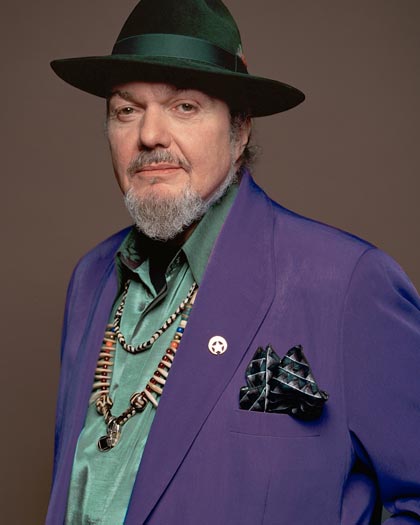
| DR. JOHN & THE NIGHT TRIPPERS AND ALLEN TOUSSAINT | ||
| Date | (Sat) Mar 16, 2013 at 8:00 PM | |
| Description | 6 Time Grammy Award
winner and Rock N’ Roll Hall of Famer Dr. John has long been considered
the physical embodiment of the vibrant culture of New Orleans.
Throughout his illustrious musical career—from his roots as a New
Orleans-based session musician to forging his distinctive
voodoo-inflected rhythm and blues psychedelia to his tireless efforts
recording, performing and being a spokesman for the city today. His
colorful persona and talents transcend musical genres and art forms
garnering respect from fans, cultural peers, civic leaders and beyond. Rock n’ Roll Hall of Famer, Allen Toussaint has crossed many paths in his illustrious 40 years plus career in music and is considered one of the most influential figures in New Orleans R&B. |
|
| Ticket Price | $55, 50 & 45 plus applicable fees | |
| How to Get Tickets | Tickets on sale now through mail order, just click here, The Town Hall Box Office, and Ticketmaster | |
| Producer | The Town Hall | |
Sunday, March 10, 2013
Upcoming: Dr. John & Night Trippers / Allen Toussaint @ Town Hall
Thursday, February 21, 2013
Premiere: Shannon McNally, Dr. John cover Bobby Charles
USA Today: Singer/songwriter and New Orleans piano great pay tribute to a Louisiana songwriting legend.
Songwriter Bobby Charles would have been 75 today.
Shannon McNally has a birthday present for the late songwriter of early rock 'n' roll hits like Fats Domino's Walking to New Orleans and Bill Haley & The Comets' See You Later, Alligator -- a sweet cover of his I Must Be in a Good Place Now, recorded with Dr. John on piano.
"It sums Bobby up pretty perfectly," says McNally. "The guy would sort of rather be fishing than doing anything else."
I Must Be in a Good Place Now will appear on the alt-country singer/songwriter's forthcoming Small Town Talk album, out April 30.
McNally previously covered Charles' Tennessee Blues on her 2005 album Geronimo. That recording led to Charles asking her to play a tribute concert at the 2007 New Orleans Jazz & Heritage Festival, where she met keyboardist Dr. John. Dr. John, aka Mac Rebennack, had played on the original version of I Must Be in a Good Place Now for Charles's 1972 debut album for Bearsville Records.
McNally floated the idea of re-recording the Bearsville album in its entirety with some of the same musicians. "To my amazement, and pleasure, they both went for it," she says.
McNally cut basic tracks for the album before Charles' death in 2010, so he was in the studio for the sessions. However, the concept of the album evolved: "There were so many great songs to choose from, and a few real gems that had never gotten released, that it turned into more of a retrospective," McNally says.
Small Town Talk still includes several songs from that 1972 album, as well as a rendition of one of Charles' better-known tunes, But I Do, originally a 1961 hit for Clarence "Frogman" Henry.
"People will recognize that song," McNally says, "people of a certain record collection or age."
Wednesday, February 29, 2012
Stream: First track from Dr. John's "Locked Down"
New Orleans legend Dr. John – a.k.a. Mac Rebennack – teamed up with the Black Keys' Dan Auerbach to record his latest album, Locked Down. "Watching him come up with parts was just so awesome. Mac is fearless," says Auerbach, who produced the set. "Like that Farfisa solo on ‘Revolution' – that’s a first-take solo. He just goes for it, man. He told me he hadn’t played a Farfisa organ since 1969 when he was with Doug Sahm, and he killed it." Locked Down won't be in stores until April 3rd, but you can stream "Revolution" today.
Wednesday, January 18, 2012
Dr. John to Lead Three-Weekend Residency at BAM; Dan Auerbach to Join in Debut of Music from New Album, "Locked Down"

Dr. John—Mac Rebennack— will lead a three-weekend residency titled Dr. John: Insides Out at the Brooklyn Academy of Music in Brooklyn, New York, March 29 through April 14. The centerpiece of the residency is a three-night run of concerts in which Auerbach will join Dr. John and a handpicked band to premiere new music from the album at the BAM Howard Gilman Opera House, April 5–7. Dr. John: Insides Out begins the previous weekend, March 29–31, with a tribute to Louis Armstrong, and concludes April 12–15 with Funky But It’s Nu Awlins, a funk-infused night of New Orleans music, featuring key players from the Crescent City.
From March 28 to April 1, BAMcinématek presents a complementary series of films shot or set in the Crescent City. Spanning five decades, the series includes Belle of the Nineties (1934), The Flame of New Orleans (1941), and Down by Law (1986), plus many more.
Tickets for Dr. John: Insides Out go on sale next Monday, January 23, for Friends of BAM, and the following Monday, January 30, for the general public. To order then, go to bam.org.
For more on Locked Down, the forthcoming Nonesuch release from Dr. John, click here.
Wednesday, March 9, 2011
NPR: Dr. John: From Session Player To New Orleans Funk Legend
LISTEN HERE
This month, five new performers will be inducted into the Rock and Roll Hall of Fame. It's an eclectic group of selections, ranging from pop diva Darlene Love to shock-rocker Alice Cooper. But in spite of their differences, each of these singers adopted a special identity or image to stand out from the rest of the pack. Morning Edition has been looking behind the personas of this year's inductees.
The recording studio was crammed with musicians — some of the best players in Los Angeles. They had all gathered to provide a wall of sound behind Sonny & Cher.
Behind the tall woman and the little man were multiple guitarists, horns and keyboard players. Among that last group was a 26-year-old pianist from New Orleans named Mac Rebennack, who was not too happy with the assignment.
"To get all these keyboard players — and they were all good players — playing blink-um, blink-um, blink-um arpeggios together, it's not very hip," Rebennack says. "And it's not very funky. And it doesn't make me want to dance."
Rebennack knew funky. He had come from one of the most vibrant rhythm-and-blues scenes in the country, and there, he'd studied the styles of local legends like Professor Longhair.
But he had been busted for drugs one too many times, and the authorities had refused to let him return home after rehab. So he went to L.A., where, in the mid-'60s, there was plenty of mind-numbing session work to be had.
Rebennack started thinking of New Orleans and a story he'd heard about a 19th century medicine man, who was revered by the poor and feared by the well-to-do. His name was said to be John Montaigne or, more commonly, Dr. John.
In 1969, Rebennack released a thematic album called Gris Gris based on the Dr. John character. The record was a mixture of rhythm and blues, jazz and voodoo chants in a Creole dialect. The album was recorded quickly by a group of expatriate New Orleans musicians during leftover studio time between Sonny & Cher sessions. For Rebennack, the hardest part was stepping out front to do the lead vocals.
Dr. John performs "Right Place, Wrong Time" on PBS' Soundstage.
Source: YouTube
"See, I don't know nothing about singing. I never wanted to be a frontman," Rebennack says. "Frontmen had big egos and was always crazy and aggravating. I just never thought that was a good idea."
No one else wanted to do it, either, so Rebennack, reluctantly, became Dr. John. When he started touring, friends from the New Orleans Mardi Gras Indians provided him with elaborate costumes, festooned with feathers and intricate beadwork. Rebennack says his goal was to preserve and promote a cultural legacy that was dying off, but the mysterious music of Dr. John connected with psychedelic rockers.
"We got some gigs playing at a love-in or a be-in or some kind of 'in,' " Rebennack says.
Since then, Dr. John's wardrobe has been scaled back to a snake-headed walking stick and some voodoo beads around his neck, and the music is straight-up funky New Orleans. But he's kept the name he took from that ancient medicine man.
"Doc has been my name all my life, and John is my middle name. I'm proud of all my names — Malcolm John Michael Creaux Rebennack," he says. "I'm proud of them names."
And has the formerly reluctant lead vocalist settled into his role as a frontman? "Yes," he says. "That's the tricknology of life."
Monday, February 21, 2011
Thursday, December 16, 2010
Dr. John a deserving Rock and Roll Hall of Fame inductee
By Keith Spera, The Times-Picayune
He’s in the right place, at the right time. Mac “Dr. John” Rebennack, an icon of New Orleans music in all its permutations for five decades, is among the 2011 Rock and Roll Hall of Fame inductees.
Jennifer Zdon / Times-Picayune archiveMac "Dr. John" Rebennack is bound for the Rock and Roll Hall of Fame.
He’ll be inducted in the Hall of Fame’s performer category alongside Neil Diamond, Alice Cooper, Tom Waits and Darlene Love at the Waldorf Astoria in New York City on March 14.
With his induction, Malcolm “Mac” John Rebennack Jr. joins a relatively short and prestigious list of New Orleans honorees. He is only the third New Orleans-area inductee in the main “performer” category. Fats Domino was included in the Hall of Fame’s inaugural class of 1986. The only other local “performer” to be inducted is Lloyd Price, who is technically a native of Kenner.
Dave Bartholomew, Domino’s producer and co-writer, was inducted as a non-performer, as was producer, songwriter and pianist Allen Toussaint.
Prolific drummer Earl Palmer was honored in 2000 as a sideman. Louis Armstrong, Mahalia Jackson, Professor Longhair and Jelly Roll Morton are all enshrined in the Hall of Fame as “early influences.”
One of two 2011 inductees in the non-performer category also has ties to New Orleans. Art Rupe founded Specialty Records in Los Angeles in the 1940s. He tapped into the deep talent pool in New Orleans by releasing Lloyd Price’s “Lawdy Miss Clawdy” and Guitar Slim’s “The Things You Used to Do,” as well as classic singles by Little Richard.
Elektra Records founder Jac Holzman will also be inducted as a non-performer. Pianist, singer and songwriter Leon Russell, currently enjoying a revival thanks to his hit collaboration with Elton John, “The Union,” will receive the Award for Musical Excellence (previously the sidemen category).
Artists are eligible for inclusion 25 years after the release of their first recording. This year’s inductees were chosen from a larger pool of nominees that included Bon Jovi, the Beastie Boys, LL Cool J, the J. Geils Band and Chic. More than 500 members of the Rock and Roll Hall of Fame Foundation voted on the inductees; voters included Keith Richards and B.B. King.
Rebennack has enjoyed a long and colorful life in New Orleans music. As a teenager, he haunted New Orleans recording studios, contributing to sessions on guitar and eventually producing records and writing songs. A gunshot wound to a finger hastened his switch to piano as his primary instrument.
In the 1960s in Los Angeles, he developed his Dr. John the Night Tripper character with expatriate producer and songwriter Harold Battiste. Dr. John borrowed equally from voodoo imagery and psychedelic rock. “Gris-Gris,” his debut as Dr. John, is considered a classic New Orleans album.
He sang his hit “Such a Night” as part of The Band’s legendary Last Waltz concert. Allen Toussaint produced Rebennack’s “Right Place, Wrong Time,” which featured the Meters as his backing band.
He continued to intermingle funk, his take on New Orleans rhythm & blues standards, and solo piano excursions. Along the way he battled a years-long heroin addiction and developed his own peculiar “fonkified” variation on the English language. He blurs lines between musical genres as well as races.
In 1992, he assembled an all-star cast to record “Goin’ Back to New Orleans,” a primer on the history of New Orleans music that is one of the most satisfying local releases of the past 20 years. His solo piano recordings are also justifiably acclaimed.
At age 70, he remains extremely active despite a number of health issues in recent years. He and his formidable band, the Lower 9-11, maintain a busy performance schedule around the world; they’ll log two nights at Tipitina’s on Dec. 29-30.
He released his latest CD, “Tribal,” this year. He also sings “Down in New Orleans,” the opening song on the soundtrack of “The Princess and the Frog,” the Disney animated film set in jazz era New Orleans.
Matthew Hinton / The Times-PicayuneMac "Dr. John" Rebennack speaks out against BP at a rally in New Orleans' Jackson Square on May 30, 2010.
In the wake of Hurricane Katrina, Rebennack emerged as an outspoken, at times angry, advocate of the city and a critic of what he perceived as the shabby official response to the disaster. His 2008 CD “The City That Care Forgot” dealt directly with that subject.
More recently, he has criticized BP for its response to the Gulf of Mexico oil spill, and worked to keep the lingering effects of the spill in the news.
Eventually all inductees are represented at the Rock and Roll Hall of Fame and Museum in Cleveland, Ohio. The March 14 induction ceremony will be broadcast from New York on the Fuse network.
As Rebennack, Russell and Waits all know their way around a keyboard, look for the piano to take center stage in the culminating jam. And with Rebennack in the house, it'll be fonky.
Saturday, November 27, 2010
Village Voice: Dining with Dr. John
Not long ago several friends and I enjoyed the most recent of a series of meals with Mac Rebennack, more commonly known by his stage name of Dr. John. One of his earliest incarnations was as The Night Tripper, a psychedelic-era character who wore African-inspired duds and melded the popular music of New Orleans with that of San Francisco. A student of the legendary pianist Professor Longhair, Mac is a multi-instrumentalist whose guitar playing career was cut short early on by a gunshot wound to the hand received while defending a friend in a bar brawl.
Though he was once a heroin addict - a defect he readily admits - he has been clean for many, many years, and now won't touch drugs of any sort or even a drop of alcohol. Nevertheless, many of his stories from the psychedelic era revolve around drugs and his many contacts with other musicians of that period. In fact, there's almost no figure you can't ask him about that he didn't know, and can't come up with a story about.
Bearded, still dressed in dandified outfits, old in years but still keen in intelligence, he is a master storyteller, and his tales are capable of distracting an audience from the world's best-tasting food.
Here, then, are some tales told during a meal at the Upper East Side's Szechuan Chalet, followed by some early videos and a few shots of the food we ate that evening. Apart from some occasional questions on my part, the rest of the prose is Dr. John's, just as he uttered it in his gravely New Orleans drawl.
Wednesday, September 29, 2010
Dr. John nominated for Rock and Roll Hall of Fame honors
New Orleans music icon Dr. John is one of 15 nominees for the 2011 Rock and Roll Hall of Fame, announced Tuesday.
The Hall of Fame released its list of nominees for induction, with plans to reveal those selected as inductees in December, with a ceremony slated for March in New York City.
To be eligible for the hall, an act must have released its first batch of music at least 25 years ago.
Dr. John, whose real name is Mac Rebennack, is a multiple Grammy award winner, whose brand of New Orleans funk and rhythm and blues has earned him a following worldwide.

Just this past week, the New Orleans recording studio, Cosimo Matassa’s J&M studios, where Rebennack recorded many of his early hits as a backup and solo performer, was named a Rock and Roll landmark by the Hall of Fame.
If Rebennack is inducted into the Hall of Fame, he will join a who’s who of New Orleanians who have been previously inducted: Louis Armstrong, Fats Domino, Allen Toussaint, Lloyd Price, Earl Palmer, Dave Bartholomew, Mahalia Jackson, Professor Longhair and Jelly Roll Morton.
Other nominees for 2011 honors include Bon Jovi, Neil Diamond, Alice Cooper and Donna Summer. Some of this year’s other nominees have been up for the honor before, including Summer, Darlene Love, LL Cool J and the Beastie Boys.
Tuesday, September 7, 2010
NPR: "Dr. John And The Lower 911 - An Unbroken 'Heart'

The organ lays down a slow and sanctified groove, as if a hymn is about to begin, but then a driving drummer speeds up the pace. The organ sings out and a percussive, bluesy piano elbows in. Dr. John is messing with our minds, sliding from church to boudoir as his charmingly grizzled voice describes how his lover has had a "Change of Heart."
With his 70th birthday coming up in November, the New Orleans singer and pianist functions as the outspoken eminence grise for his battered city. His lively new album Tribal trots out jazzy, jive-y riffs and political statements about America's problems. Yet Dr. John (a.k.a. Mr. Malcolm John Rebennack Jr.) sounds his most relaxed on old-school love songs like "Change of Heart," a self-written exemplar of classic rhythm and blues with a jaunty New Orleans twist. The storyline is old-school, too: The woman he adores has stepped out with another man. He doesn't know what to do, except go out and find someone new himself.
The song ends on a mournful note — "She really hoit me so" are its last words — but "Change of Heart" isn't a downer thanks to the power of Dr. John's spirit. Musically and lyrically, he's made it clear that his broken-hearted narrator is moving on. Maybe that's a political statement in and of itself.
Monday, August 30, 2010
Time: "10 Questions for Dr. John"
![]()
I feel like things still aren't right around New Orleans since Hurricane Katrina. Do you think the city will ever be the same? —Christopher Gustin, ARABI, LA.
Considering that over half the population is not back, I don't see how it could ever be [the same]. The Ninth Ward is still destroyed. People have nowhere to come home to. They got burned by the insurance companies. They got burned by everybody.
Do you think the people of Louisiana are in better shape now than they were in 2005? —Jose Mejia, BROWNSVILLE, TEXAS
No. All of the dispersants, all of the poisons that have been put in the Gulf are killing every critter that walks, flies, swims. All of the poor fishermen out there that for generations have earned their livelihood fishing are being wiped out.
What is the one thing New Orleans needs the most post-Katrina and post-BP? —Terri Fallin, NEVADA, MO.
One of the things it needs most desperately is leadership. We've never had any. This is a pathetic thing to say about my home. We're good people, but I feel like oil companies own our politicians outright. (See pictures of Katrina's survivors and heroes.)What is it about New Orleans that so inspires musicians? —Waheed Akberzie, SIMI VALLEY, CALIF.
We have a culture, for one thing. I think we're the only state in the U.S. that actually has its own culture. It overlaps into the food, into the music, into the lifestyle of our people. We live on sacred lands that are being terribly abused.How have the spirits and ancestors of New Orleans music influenced you? —Eoghan Ballard, PHILADELPHIA
I pray to them all the time, all of my musical ancestors, from Jelly Roll Morton to Buddy Bolden to Louis Armstrong. I'm proud I grew up in his neighborhood, the Third Ward. My father used to say, "That's where Louis Armstrong was born." He never called him Louie. He never called him Satchmo. "That's where Louis was born."
How would you describe your own music? —Denis Murrell, MACAU
I like to think of what Duke Ellington said about music: There's only two kinds of music — good and bad. I would like to think my music is good. I try to make music that tells truths. (See pictures of Dr. John.)What musicians would you most like to collaborate with? —Dave Krolak, BASKING RIDGE, N.J.
That's an unanswerable question for a guy like me. It's not like I listen to people's music and say, "I like that. We'll write great songs together!" People who can write fast — bing, bang, boom — that's the kind of people I like to write with. I don't think I could ever write a song with Randy Newman. He takes forever to write a song and finesses it to the point where it's wonderful. That's not how I like to do it. I can write two, three, four songs in a day.
You used to be a guitar player but switched to piano. Why? —Keith Watling, MILWAUKEE
One day I walked in on Ronnie Barron — he was a kid singing with our band — and this guy was pistol-whipping him. Now, his mother said that if anything happened to him on the road, she was going to take her meat cleaver and cut my cojones off. So I went and tried to get the gun out of the guy's hand. I got shot in my finger. It was sewed back on, but it messed up part of my head where I thought, Oh, I can't play the guitar anymore. I still play it a little bit, but not the way I used to.
What do you think of the HBO series Treme? —Jay Combe, NEW ORLEANS
I don't watch television. I don't own a television. I don't want one. But I saw the premiere, and the guy who plays the teacher — oh, God, I can't even tell you his name [Eds.: John Goodman] — he danced with my mother at her 90th-birthday party. His character on the show talks truth, about why we're constantly treated like a third-world country down here in Louisiana.
Is there any other city in the world that you could live in? —Trey Comeaux, NEW ORLEANS
No. I love my roots and my heritage. I've tried living in other places — I lived in New York City once. But New Orleans is where my heart is.
Thursday, August 26, 2010
PopMatters Review: Dr. John and the Lower 911's "Tribal"
By Jonathan Kosakow

(429; US: 3 Aug 2010; UK: 28 Jun 2010)
New Orleans’ very own Dr. John has a familiar sound. The swampy jazz, funk and soul of the Bayou has flowed forth from him since the 1960s, at times following different directions, but always staying true to its roots. The piano swoons, the bass swings, and his gravely vocals lay truth on the line. It’s a comforting sound, one that touches the soul. His latest, Tribal, played with backing band The Lower 911, does just what we’ve come to expect from the good Doctor. A follow-up to his 2008 album, The City That Care Forgot, in which he took anger out on those who let his beloved city stand hurting, Tribal makes no secret of his continued displeasure with the state of affairs in this country.
The album starts out on a positive note with “Feel Good Music”, a slow funk proclaiming, “I’m a feel good doctor and I don’t lose/make ya feel good and ya won’t refuse”. But he wastes no time getting to the thick of things, as “Lissen At Our Prayer” begs our respect for all life, and “Big Gap” (co-written with Allen Toussaint) attacks the financial class differences becoming evermore present in the United States. The title track sums up the general message of the album: all humans are one, so we must live together and help each other.
The album also features some tunes of a lighter tone. “When I’m Right (I’m Wrong)” and “Jinky Jinx” take some playful jabs at his own faults in the world of life and love. A shout-out is given to the world champion New Orleans Saints with a “Who Dat!?” chant thrown into “Sleepin’ in my Bed”, and “What’s Wit Dat” has so much hop, it could physically pick you up and move your feet for you.
The hardest hitting tracks come towards the end. “Them”, also co-written by Touissant, is a spooky tune, and asks whom we will blame next for our problems (there’s always someone else, after all). “Manoovas” is four minutes of electric blues featuring the slide guitar of Derek Trucks alongside a dark, driving bass line.
Tribal is not just another Dr. John album, nor is it simply a call for action (neither of which would be at all painful, by the way). The poignant lyrical message conveyed through most of the album, coupled with the ability of the music to keep you uplifted, is perfectly reminiscent of the spirit of New Orleans. Even though times could be better, there is always a reason to go on.
Tuesday, August 24, 2010
NY Times: Dr. John - Gumbo Along the Hudson
IT was another scorching day in New York, but in his short-sleeve shirt, black jeans and snakeskin shoes, Dr. John, the piano-playing, politically assertive singer and songwriter from New Orleans, was quite comfortable.
“I don’t like to be cold,” said Dr. John, who was born Malcolm John Rebennack Jr., and is known to his friends as Mac.
At 6 on a recent evening, he was making his way along West Harlem Piers Park on 125th Street and the Hudson River. The sun was still bright and the water beckoned. Cyclists whizzed by; children ran down the walk. No one seemed to recognize the Grammy-winning performer, who adopted his stage name from a voodoo practitioner who lived in the early 1800s.
Not that he didn’t stand out with his wooden walking stick, which he clutched like a scepter; it was adorned with voodoo beads, key rings from Narcotics Anonymous, a yak bone, a subway token, an alligator tooth, feathers and crystals.
Now 20 years heroin-free, Dr. John could pass for a decade younger than his 69 years; his face is barely lined. On this particular day he said he was tired, having recently completed a monthlong European tour to promote his latest album, “Tribal” — a gumbo of jazz, funk and rock peppered with Creole and R & B — which was released earlier this month.
He sat down on a bench and lighted a Dominican cigar (which he calls a “square”) and said he liked it there, by the water; it reminded him of New Orleans, his hometown, where he spends much of the year. He also rents a “pad” in Washington Heights, where he stays on and off and where many of the residents are Hispanic. “It’s nice,” he said. “I relate to people up there that kind of hangs on the streets.”
Does he speak Spanish? “No,” he said. “I don’t even speak English.”
In a way, he’s not kidding. Talking with Dr. John is an adventure. And a treat. After all, this is the guy who is responsible for lyrics like “I walk on gilded splinters.”
Still, it can be challenging to follow him. His voice hovers between a growl and a whisper, and made-up words burst from his lips. A message is a “massage.” A text becomes a “textile.” Louisiana’s governor, Bobby Jindal, is “Bobby Jingle Bells,” as in: “For a minute during the BP mess, I liked Bobby Jingle Bells. For a minute.” And now? “He’s the kind of politician who makes me nauseated.”
He can also be vague. When asked how many children he had, he answered “A lot.” And how many grandchildren? “Enough.”
His conversation meanders with seemingly no connective thread; eventually, certain themes emerge: Louisiana, offshore drilling, Hurricane Katrina, the joys of eating goats’ eyeballs (“When you get the hard part out, they’re delicious”) and drinking, which he never enjoyed. “I killed all my mother’s plants ‘cause I poured wine in there,” he said.
And then there is Barack Obama, “The first person I voted for since John Kennedy who won,” he said. “For a lot of years I didn’t vote. After Nixon and Reagan I got disgusted with politics.”
He still is. Indeed, on this topic he is quite articulate. “I’m sitting in Europe and I see Barack Obama on TV being nice to the British prime minister” after the BP oil spill. “I ain’t prejudiced against British people. I got friends who are British. But did we really win the Revolution?”
“I don’t feel like I can trust anybody, anywhere,” he said. For that reason, he doesn’t read newspapers and doesn’t have an e-mail address or even a computer. But he does have a cellphone (Louis Armstrong’s music is one of his ringtones), which compensates for the lack of e-mail: “I can text on the phone, and even then I know it’s being monitored somewhere by someone.”
He is outraged by the government’s response to the Gulf of Mexico oil spill and Hurricane Katrina. His 2008 album, “City That Care Forgot,” which is about New Orleans after the deluge, won the 2009 Grammy for best contemporary blues album. He is still collecting money for New Orleans charities. On his Web site, drjohn.org, he notes that “As a gesture of thankfulnessments to his fans and with no profitabilitary to hisself, Dr. John is offerin’ up some drawers in honoroficalness of NOLA, his hometown.”
Does he have hope that things will improve? He shrugs. “One day you’re on top of the world, and the next day the world’s on top of you,” he said. “That’s life.”
As for him right now? “I’m somewhere in the middle.”
Monday, August 16, 2010
NPR's "Dr. John: Righteous Anger, Graced By Wit"
So many famous folks are turning 70 this year — from Ringo Starr to Al Pacino to Nancy Pelosi — it almost seems like the hip thing to do. But among the musicians hitting the milestone, Dr. John of New Orleans, the eternal Nighttripper, is alone in hitting a creative peak not heard since his youth. His new album, Tribal, along with 2008's The City That Care Forgot, present a veteran wizard who blends blues, rock, soul, pop and his own take on New Orleans voodoo-music that he calls "fonk." These days, he sounds wise but juicy, righteously angry but graced by wit.
The endless horrors wrought by Hurricane Katrina seem to have roused Dr. John out of an autumnal trance, as it did other New Orleans natives Randy Newman and Allen Toussaint. In the 1990s and early 2000s, Dr. John was thumbing through America's back pages — the songbooks of Johnny Mercer and Duke Ellington, for example — not responding to current headlines. No question, these ruminations were delightful, full of ideas and never tossed off. But Dr. John wasn't worked up, didn't develop a head of steam.
That changed with City That Care Forgot. Dr. John had never made such a protest album, filled with broke-down people, built-up profiteers and pithy lines like, "Life is a near-death experience." One prophetic highlight was "Black Gold," which could serve as the anti-anthem to the Gulf oil spill.
City That Care Forgot was heavy with star turns from the likes of Eric Clapton and Terence Blanchard. And if the guest appearances on the new Tribal are more low-key, they're also less of a distraction. And despite caustic numbers like "Big Gap" and "Only in America," Tribal is not as angry an album as City That Care Forgot. "Whut's Wit Dat," for example, is a droll complaint about the oceans of fast food everywhere. Other numbers are brain-teasers with philosophical points. A vocal duet with drummer Herman Ernest, "Them," pokes fun at people addicted to blame.
Dr. John, a.k.a. Mac Rebennack, has always been a bone-deep professional, and part of that means not dropping out of the game and being ready to respond when inspiration — or outrage — strikes. Part of professionalism also means knowing that exposure on a hot TV show like Treme indicates that it's time to give it all you've got on record.
And Dr. John has done that. Tribal has the grandeur and savvy of your favorite crazy uncle. People don't appreciate how tricky it is to deliver this persona in popular music. Loudon Wainwright III hits it at times, Bob Dylan and John Prine stumble across it regularly. Richard Thompson should try to find it more often. But none of them will be as fonky as Dr. John.
Tuesday, August 3, 2010
Upcoming: Dr. John & Lower 911 Play Second Night @ City Winery Tonight

Dr. John, or Mac Rebennack as known to friends and family, is universally celebrated as the living embodiment of the rich musical heritage exclusive to New Orleans. His very colorful musical career began in the 1950s when he wrote and played guitar on some of the greatest records to come out of the Crescent City, including recordings by Professor Longhair, Art Neville, Joe Tex and Frankie Ford. A notorious gun incident forced the artist to give up the guitar and concentrate on organ and piano. Further trouble at home sent Dr. John west in the 1960s, where he continued to be in demand as a session musician, playing on records by Sonny and Cher, Van Morrison and Aretha Franklin to name a few. He also launched his solo career, developing the charismatic persona of Dr. John The Night Tripper.
Adorned with voodoo charms and regalia, a legend was born with his breakthrough 1968 album Gris-gris, which established his unique blend of voodoo mysticism, funk, rhythm & blues, psychedelic rock and Creole roots. Several of his many career highlights include the masterful album Sun, Moon and Herbs in 1971 which included cameos from Eric Clapton and Mick Jagger and 1973’s In The Right Place, which contained the chart hits “Right Place Wrong Time” and “Such A Night.” Dr. John garnered Grammy award wins in 1989, 1992, 1996 and 2000. In 2004, his musical love letter to the city of New Orleans, “N’awlinz Dis Dat or D’udda,” was awarded the prestigious AcadĂ©mie Charles Cros 57ème Palmarès award in France. It was the first time since the 1970s that an artist from North America received the award.
He has also received six other nominations over the years. In 2007 he was nominated for a Grammy for “Sippiana Hericane,” his Hurricane Katrina benefit disc. Other awards include the American Society of Young Musicians 2007 Trailblazer Award. After Hurricane Katrina and government bunglers bashed New Orleans in 2005, Dr. John immediately stepped up to the plate with both generous relief fund-raising concerts and recordings and angry public words of protest. One of the Crescent City's most favored sons, Dr. John does his considerable bit to keep the world's attention focused on what needs to be done to help New Orleans come back.
In 2008, he released the album “City That Care Forgot,” which deals with various aspects of post-Katrina New Orleans and the Gulf Coast. In 2009, “City That Care Forgot” won the Grammy for “Best Contemporary Blues Album.” It is considered to be his finest recording in twenty years. After a half century of creating music for others and himself, Dr. John continues to write, arrange, produce and interpret with a passion that has yet to wane. He continues to dazzle and delight audiences across the globe touring consistently. In fact, Dr. John, veteran of decades in music, is at the height of his creative output right now, having recently released grandly-conceived tribute albums to Duke Ellington and Johnny Mercer, and having famously revived his full-blown, magnificently-costumed 'Dr. John, the Night Tripper' stage persona in June 2006 at the Bonnaroo Music Festival.
Dr John brings his band 911 to the stage for two unforgettable nights of N'awlinz swamp funk, deep in the sultry summer sweat that is New York City in August. Don's miss these shows, no matter what.
Wednesday, July 28, 2010
Profile: Dr. John the Night Tripper
Mac Rebennack a/k/a Dr. John is, perhaps, the best-known and beloved musician to come out of New Orleans. From his early work as a session player and producer during the 1950s, to his solo recordings of the 1960s and '70s, Dr. John's fingerprints can be found on much of the best music to come out of New Orleans over the past six decades. While his tireless efforts on behalf of the victims of Hurricane Katrina have made him the city's musical ambassador to the world, his musical legacy has cemented his status as an elder statesman of a great city and musical tradition.(click on title for full article)
Thursday, December 31, 2009
In Pictures: Dr. John & Lower 911 @ Highline Ballroom
Tuesday, December 22, 2009
Upcoming: 1/2 Price Dr. John Tickets @ Highline Ballroom

Dr. John & The Lower 9-11 at HighLine Ballroom
HighLine Ballroom (New York City, NY)
Tuesday, Dec. 29 @ 9:30pm (Doors Open at 9pm)
Wednesday, Dec. 30 @ 9:30pm (Doors Open at 9pm)
Full Price: $35.00
Our Price: $17.50
Dr. John & the Lower 9-11 features Mac Rebennack, commonly known at Dr. John the Night Tripper, playing a blend of funk, r&b, psychedelic rock, jazz and Creole roots. In the '50s, Dr. John played guitar on some of New Orleans' greatest records, before an injury forced him to switch to piano. Notable for his eccentric costumes, including voodoo charms and robes, Dr. John has recorded with Sonny and Cher, Van Morrison and Aretha Franklin.
Thursday, July 16, 2009
Ponderosa Stomp @ Lincoln Center Starts Tonight, to be broadcast on WFMU
c/o Brooklyn Vegan

The first two nights of The Ponderosa Stomp at Lincoln Center, July 16th and 17th are part of Lincoln Center's Midsummer Nights Swing, taking place at Damrosch Park. Each night kicks off with a dance lesson at 6:30 and the music starts at 7:30. Thursday night features The Get Down, a night of soul music excellence featuring William Bell, Harvey Scales, The Bobbettes and the incomparable Bo-Keys. Friday night brings rockabilly to the forefront with the Best Dance in Town, in which New Orleans wild man Joe Clay, Sun Record's Carl Mann and the legendary brother/sister duo The Collins Kids throw down, backed by Deke Dickerson and his Eccofonics.The Ponderosa Stomp @ Lincoln Center's first night, The Get Down, will be broadcast live on WFMU. The second, July 17th, will be recorded for a later broadcast on July 30th. Tickets for the events are still on sale.Sunday, July 19th, a tribute performance takes place at Alice Tully Hall in the Starr Theatre, in which a high-octane array of Stomp artists will pay musical tribute to the "Creole Beethoven", Wardell Quezergue. Quezergue, nicknamed by Allan Toussaint, has made musical history countless times as the man behind timeless hits like "Mr. Big Stuff", "Iko Iko" and "Chapel of Love". A genius musician, arranger and producer who is largely unknown outside of New Orleans, Quezergue helped shape the soulful sounds of the south into international hit records. The show features R&B icons The Dixie Cups and Robert Parker; soul greats Jean Knight, Dorothy Moore, Tammy Lynn, and Tony Owens; legendary New Orleans drummer Zigaboo Modeliste; New Orleans musician, producer, and session man Mac Rebennack (Dr. John); garage-music pioneer Michael Hurtt; plus Wardell Quezergue's Rhythm & Blues Orchestra, an all-star ten-piece band led by Quezergue himself in a rare New York appearance.
More info on the Stomp and the full lineup of performers (or you can check out "virtual trading cards" for each), below...
Ponderosa Stomp info
The Ponderosa Stomp Concert, a New Orleans musical tradition, highlights the world's most authentic musicians of rockabilly, R&B, jazz, blues, garage, soul, funk, and swamp pop. The annual show has become a must-see event, functioning as a showcase for living musical history. The Ponderosa Stomp exists to acknowledge, pay tribute to, and teach the cultural significance of the unsung heroes and heroines of rock-n-roll, rhythm & blues and other forms of American roots music. Events in New Orleans every spring include two jam-packed nights of music, a conference and symposium, film festival, record hop and now, a museum exhibit. Unsung Heroes: The Secret History of Louisiana Rock & Roll is currently on display at the Louisiana State Museum in the historic Cabildo in the heart of the French Quarter, running through May 2010. Lincoln Center and the Stomp teamed up together to produce three nights of music this week celebrating stars of rockabilly, soul and R&B.July 16th (Midsummer Night's Swing):Ponderosa Stomp: The Get Down
* William Bell - a principal architect of the Stax/Volt sound.
* The Bobbettes - girl group known as the 'Harlem Queens' known for their hit, "Mr Lee"
* Bo-Keys - authentic, greasy Memphis soul stew w/ Stax Records stars
* Harvey Scales - a hard-hitting soul man, writer of "Disco Lady" and "Love-i-tus"
July 17th (Midsummer Night's Swing):Ponderosa Stomp: Best Dance In Town
* Joe Clay - New Orleans' proto-rockabilly genius, appeared with Elvis
* The Collins Kids - 50's TV faves, this brother/sister duo features double neck guitarpyrotechnics
* Deke Dickerson & The Eccofonics - the nitro-charged country and rockabilly specialists
* Carl Mann - Sun Records artist had his first hit with Nat King Cole's "Mona Lisa"
July 19th (Lincoln Center Festival): A Tribute to "The Creole Beethoven,"
Wardell Quezergue, celebrated New Orleans arranger and mastermind behind
countless rhythm and blues classics. On the bill:
* The Dixie Cups - hit makers who recorded classics, "Chapel of Love" and "Iko Iko."
* Jean Knight - New Orleans-based singer of "Mr. Big Stuff."
* Tammy Lynn - soul singer and legendary background singer for the Rolling Stones, Dr. John, and countless others.
* Zigaboo Modeliste - New Orleans master drummer and member of funk originators the Meters.
* Dorothy Moore - Malaco Records' soul/blues balladeer.
* Tony Owens - Lost soul king of New Orleans.
* Robert Parker - recorded his hit record, "Barefootin'" with Querzegue
* Mac Rebennack - New Orleans musician/producer/arranger/ songwriter better known as Dr. John.
Wednesday, March 11, 2009
Upcoming: Ponderosa Stomp @ Lincoln Center
The Ponderosa Stomp Concert, a New Orleans musical tradition, highlights the world’s most authentic musicians of rockabilly, R&B, jazz, blues, garage, soul, funk, and swamp pop. The annual show has become a must-see event, functioning as a showcase for living musical history. The Ponderosa Stomp exists to acknowledge, pay tribute to, and teach the cultural significance of the unsung heroes and heroines of rock-n-roll, rhythm & blues and other forms of American roots music. The Stomp began when a group of like-minded friends began presenting shows at a small club; it has evolved into a multi-faceted musical, cultural and educational juggernaut. Events in New Orleans every spring include two jam-packed nights of music, a conference and symposium, film festival, record hop and now, a museum exhibit. Unsung Heroes: The Secret History of Louisiana Rock & Roll is currently on display at the Louisiana State Museum in historic Cabildo in the heart of the French Quarter, running through May 2010.
American Routes, the nationally syndicated roots music show, recorded interviews and live performances at the New Orleans Stomp in late April 2009. As part of the 4th of July show, American Routes will air this show the week of Independence Day, listeners can check their local listings for specific days and times in each market.
The organization behind the show and conference, The Ponderosa Stomp Foundation, is dedicated to celebrating the legacy, revitalizing the careers and preserving the history of the architects of American music. By providing them a voice and a stage, many Stomp performers enjoy increased visibility as well as new recording and performing opportunities.
For 47 years Lincoln Center for the Performing Arts has been a national leader in programming for the arts. As presenter for 400 events annually, there are few institutions as dedicated to the preservation and performance of a myriad of musical genres, dance and other art forms. The collaboration between the Ponderosa Stomp and Lincoln Center is a perfect pairing of two organizations with a mission: to expose and celebrate incredible music and help preserve traditions with transcendent cultural value.
The first two nights of The Ponderosa Stomp at Lincoln Center, July 16th and 17th are part of Lincoln Center’s Midsummer Nights Swing, taking
place at Damrosch Park. Each night kicks off with a dance lesson at 6:30 and the music starts at 7:30. Thursday night features The Get Down, a night of soul music excellence featuring William Bell, Harvey Scales, The Bobbettes and the incomparable Bo-Keys. Friday night brings rockabilly to the forefront with the Best Dance in Town, in which New Orleans wild man Joe Clay, Sun Record’s Carl Mann and the legendary brother/sister duo The Collins Kids throw down, backed by Deke Dickerson and his Ecco-fonics.
Sunday, July 19th, an tribute performance takes place at Alice Tully Hall in the Starr Theatre, in which a high-octane array of Stomp artists will pay musical tribute to the Creole Beethoven, Wardell Quezergue. Quezergue, nicknamed by Allan Toussaint, has made musical history countless times as the man behind timeless hits like “Mr. Big Stuff”, “Iko Iko” and “Chapel of Love”. A genius musician, arranger and producer who is largely unknown outside of New
Orleans, Quezergue helped shape the soulful sounds of the south into international hit records. The show features R&B icons The Dixie Cups and Robert Parker; soul greats Jean Knight, Dorothy Moore, Tammy Lynn, and Tony Owens; legendary New Orleans drummer Zigaboo Modeliste; New Orleans musician, producer, and session man Mac Rebennack (Dr. John); garage-music pioneer Michael Hurtt; plus Wardell Quezergue’s Rhythm & Blues Orchestra, an all-star ten-piece band led by Quezergue himself in a rare New York appearance.

July 16th (Midsummer Night’s Swing): Ponderosa Stomp: The Get Down:
* William Bell – a principal architect of the Stax/Volt sound.
* The Bobbettes – girl group known as the Harlem Queens known for their hit, Mr Lee
* Bo-Keys – authentic, greasy Memphis soul stew w/ Stax Records stars
* Harvey Scales – a hard-hitting soul man, writer of ”Disco Lady” and “Love-i-tus”
July 17th (Midsummer Night’s Swing):Ponderosa Stomp: Best Dance In Town:
* Joe Clay – New Orleans proto-rockabilly genius, appeared with Elvis
* The Collins Kids – 50 TV faves, this brother/sister duo features double neck guitar pyrotechnics
* Deke Dickerson & The Eccofonics – the nitro-charged country and rockabilly specialists
* Carl Mann – Sun Records artist had his first hit with Nat King Cole’s “Mona Lisa”
July 19th (Lincoln Center Festival): A Tribute to “The Creole Beethoven,” Wardell Quezergue, celebrated New Orleans arranger and mastermind behind
countless rhythm and blues classics. On the bill:
* The Dixie Cups – hit makers who recorded classics, “Chapel of Love” and “Iko Iko.”
* Jean Knight – New Orleans-based singer of “Mr. Big Stuff.”
* Tammy Lynn – soul singer and legendary background singer for the Rolling Stones, Dr. John, and countless others.
* Zigaboo Modeliste – New Orleans master drummer and member of funk originators the Meters.
* Dorothy Moore – Malaco Records’ soul/blues balladeer.
* Tony Owens – Lost soul king of New Orleans.
* Robert Parker – recorded his hit record, “Barefootin with Querzegue”
* Mac Rebennack – New Orleans musician/producer/arranger songwriter better known as Dr. John.