Just inside a room on the second floor of the Louisiana State
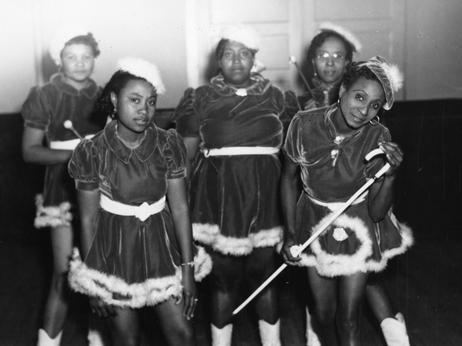
Museum's Presbytere, there's a large baby doll dress, big enough for a
woman to wear. And one did.
The costume and the baby bottle
next to it belonged to 85-year-old Miriam Batiste Reed, who was known as
a baby doll and one of the first women to parade in Mardi Gras. The
bottle and the dress are part of a new exhibition, They Call Me Baby Doll: A Mardi Gras Tradition.
"The
baby dolls are a group of African-American men and women carnival
maskers," says Kim Vaz, dean at Xavier University. "They would dress up
on Mardi Gras day in short satin skirts, with bloomers, and they would
have garters."
Vaz, who has written a new book about the baby
dolls, says the tradition dates back to 1912, when Jim Crow was the law
of the land in the South. It all started in New Orleans' red-light
district, which itself was divided along racial lines. The Storyville
area, where the sex industry was legal, was for white customers; black
customers had to go a few blocks away where prostitution was illegal,
but allowed.
"[It was] another manifestation of how Jim Crow worked to
disenfranchise black people, even in the most sordid of industries," Vaz
says.
Between these two red-light districts, there was a kind
of rivalry. One year the women in the black district heard that their
counterparts in Storyville were going to dress up for Mardi Gras; they
decided they needed to come up with some good costumes to compete. "And
they said, 'Let's just be baby dolls because that's what the men call
us. They call us baby dolls, and let's be red hot,' " Vaz says.
Calling
a woman "baby" had just made its way into the popular lexicon, with
songs like "Pretty Baby" written by New Orleans native Tony Jackson.
There was, however, something subversive about black sex workers
dressing this way. "At that time, baby dolls were very rare and
very hard to get," Vaz says. "So it had all that double meaning in it
because African-American women weren't considered precious and
doll-like."
Just the fact that these prostitutes were masking
and going out into the street at all was a big deal. Women just did not
do that then. And as sex workers, these women were already taboo. Vaz
says they just kept piling on by appropriating males behaviors like
smoking cigars and flinging money at the men. "If you went to touch their garter, they would hurt you," she says.
The
baby dolls carried walking sticks they would use in their dances, as
well as to defend themselves. It was about fun, Vaz says, but it was a
kind of laughter to keep from crying. "At that time ...
residential segregation was practiced, job discrimination was practiced
[and] women didn't have the right to vote," she says. "The one way that
they could make a statement was through their dance and their dress and
their song. It's when you've exhausted all your legal remedies that you
have to use the culture to make a statement and express yourself."
They
came up with their own dance step they called "walking raddy." Pretty
soon, women in more "respectable" neighborhoods started masking baby
doll. But desegregation in the 1950s allowed black New Orleanians to do
more on Mardi Gras. Then Interstate Highway 10 was built
directly through the neighborhood where African-Americans gathered to
celebrate carnival, disrupting many traditions. The baby dolls faded,
until several years ago.
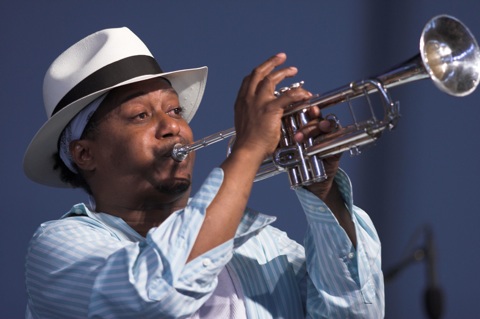
Kermit Ruffins says he has cut a deal to lease the former home of Ernie K-Doe’s Mother-in-Law Lounge.
David Grunfeld / The Times-PicayuneKermit Ruffins, seen here at Bullet's, already leases Sidney's Saloon in Treme. He plans to open a second Treme bar in the old Mother-in-Law Lounge.
Ruffins and the building’s owner have agreed on terms for a longterm lease and expect to sign paperwork by early next week, Ruffins said. He hopes to open by Mardi Gras.
“I jumped on it before anyone else did,” he said Thursday.
Ruffins has a month-to-month lease on the nearby Sidney’s Saloon, where he sometimes performs. He is a hands-off owner. He books the occasional band, but mostly leaves the day-to-day operation to a manager.
He anticipates a similar arrangement at his new bar. “I’m going to have as much live music as I can,” he said.
The ramshackle barroom at 1500 North Claiborne Avenue served as the headquarters for rhythm & blues eccentric Ernie K-Doe, purveyor of the hit “Mother-in-Law.” After K-Doe’s death in 2001, his widow, Antoinette, operated the Mother-in-Law Lounge as a shrine to her late husband – complete with a life-size mannequin she dressed in the real K-Doe’s clothes – and quasi-community center for an assortment of Treme old-timers and young, bohemian musicians.
Antoinette died of a heart attack on Mardi Gras morning 2009. Her daughter Betty Fox, manager of an auto-parts store in Memphis, Tenn., moved to New Orleans and took over the Mother-in-Law Lounge. But she struggled with various financial and logistical challenges, cars crashing into the front door, and the fact that she wasn’t her irrepressible mother.
“The only person who could run Ernie K-Doe’s Mother-in-Law Lounge was Antoinette K-Doe,” Fox said in December. “I did all I could do. I’m exhausted. It’s too stressful.”
She closed the Lounge after a Dec. 12 farewell show, and cleared out the remaining K-Doe memorabilia.
Ruffins says he has not yet settled on a name for the new enterprise. He’s unsure if it will include the words “Mother-in-Law.”
Michael DeMocker / The Times-PicayuneMourners line up outside Ernie K-Doe's Mother-in-Law Lounge in February 2009 to pay their respects to Antoinette K-Doe. Kermit Ruffins says he wants to preserve the exterior murals by artist Daniel Fuselier.
Fueled by Antoinette K-Doe’s legendary red beans and rice, artist Daniel Fuselier worked off-and-on for seven years to cover the exterior of the two-story building with dozens of vibrant, larger-than-life renderings, including cartoonish portraits of the K-Does. Regardless of what Ruffins names the new bar, he intends to leave the murals in place.
“I can’t mess up that beautiful artwork,” he said. “The outside is going to stay the same.”
Mother in law Lounge in New Orleans is finally closing - for real.
The chance of seeing Ernie K-Doe at Jazzfest was a prime reason for me going to New Orleans for the first time in 1989, and in subsequent years up to his death in 2001. I went to the Lounge several times and it's sad that it is shutting down. It was a shrine to Ernie, with dozens of rather tacky K-Doe souvenirs, historic photos and his life sized mannequin taking pride of place. Under Antoinette K-Doe's energetic management it became quite a trendy night spot for a while, but once she died the end of the Lounge was an inevitability. I'm glad I and other Woodies made a pilgrimage there during out Stompin' trip in the spring.
In homage to Ernie and the Mother In law Lounge, here are some of the K-Doe related photos I've taken over the years. First, here's K-Doe in typical slightly dishevelled pose at Jazzfest in 1989.
Betty Fox, the daughter of Antoinette K-Doe, announced on her Facebook page that she is closing down Ernie K-Doe's Mother-In-Law Lounge for good. The colorful bar at 1500 N. Claiborne in Treme has been difficult for Fox to maintain since Antoinette died on Mardi Gras Day, 2009. Fox was hospitalized March 1 after a car crashed into the bar, damaging the front door and leaving her "physically and emotionally tired of doing this. I'm grieving, too. I'm losing weight. I've been living upstairs with no plumbing, or electricity, and mold in the room for a year and a half."
"I know a lot of people might not understand," she said. "But my mother and K-Doe been gone, and each one of us has our own memory of them. This is just a building."
Fox plans to hold the last in a series of garage sales of K-Doe and Antoinette memorabilia as well as some of the bar's fixtures on July 10. Though she is behind in the rent and the building has suffered structural and mold damage, Fox holds out hope that the Mother-In-Law could be turned into a museum, an eventuality that seems unlikely without a serious financial intervention.
Kermit Ruffins: From tailgating. I started tailgating at Vaughn’s during break-time so the guys could have something to eat. So one morning I woke up and said “Kermit Ruffins and the Barbecue Kings,” but by the middle of the evening I had changed it to “Kermit Ruffins and the Barbecue Swingers.” I was having so much fun barbecuing during the show that it just hit me: “Barbecue Swingers”.
Even on a sultry, drizzling June night in New Orleans, Preservation Hall packs them in. Fortunately, the tourists who come searching for the traditional jazz that was born in this city are served up the real music that locals might take for granted. What makes it different from some tourist destinations is that the history of jazz lives within its chipped cement walls as well as in the musicians that play within its environs. Those of us who live in New Orleans know these guys such as bassist Walter Payton, who taught many a youngster who attended McDonogh 15 in the Quarter and have gone on to enjoy professional careers themselves. Musicians who have jazz running through their veins-like trumpeter Mark Braud of the legendary Brunious family and Joe Lastie whose Ninth Ward clan helped to create and carry on New Orleans music-remain regulars here.
Right off the bat, his chops were in full force. Toussaint isn’t flashy, never was – like many songwriters from his genre and his era, he doesn’t waste notes getting to the point, with a warmly chordal, staccato, even percussive attack. Nor is he a flashy singer, which was especially noticeable as the sound engineer fiddled with his vocals in the mix, but did a capable job nonetheless. He played the old stuff first: There’s a Party Going On, Here Comes the Girl and a long, tasty, fluidly soulful version of the minor-key We Got Love, which he wrote for Dorsey well over forty years ago. Then he did a medley including A Certain Girl, Mother-in-Law, Fortune Teller and Working in a Coal Mine. The Pointer Sisters’ hit Yes We Can Can was reinvented and vastly improved as yet another soul/funk number, as was another unfamiliar tune (at least to anyone who knows nothing about lite FM) apparently made famous by Bonnie Raitt.
Terrance Simien embraces and reveals the cultural connections throughout the African diaspora in his Zydeco music and his educational performances/CD, Creole for Kidz and the History of Zydeco. While traveling around the world, the Grammy-winning accordionist and vocalist, who closes the French Market Stage at the New Orleans Vieux To Do on Sunday, June 14, continues to discover the aspects that tie his Creole heritage to people in faraway lands. In the Seychelles - islands off the coast of Africa in the Indian Ocean - he was surprised by the many things he shared with the residents.
Joe Krown Q&A Podcast Joe Krown is a New Orleans-based keyboard, piano, and organ master.
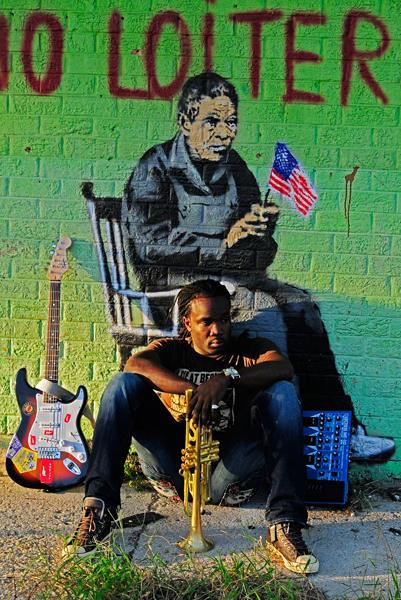
Like a lot of creative types, trumpeter Christian Scott is hard to stuff into a genre box. First, there's the clear sound of his horn, the one with the oddly angled bell. It's unmistakably part of a grand New Orleans tradition that reaches back to Louis Armstrong: a lone, expressive voice that projects its own personality as much as it does virtuosity. He could easily be playing gigs in the style of traditional New Orleans music or in the post- bop style practiced by another Crescent City hero, Wynton Marsalis.
So I've been sorta hinting at how I want to break into Gospel a bit. I haven't really ever considered myself Christian except by birth as it clashed with my preteen love of dinosaurs, but I find it hard to take issue with the passionate hollerin' that comes out of (black) gospel music.
So for a class I decided to a do a presentation on it for my final project. I'm not exactly an expert now, but I found some pretty stomp-worthy stuff. And I'm about to give you a real quick tour. Most of this stuff is actually pretty basic and blogged about in plenty of places, but I'm willing to guess that a lot of y'all are just as dumb as I was about this stuff. I'm not attempting a full-on history lesson here, just sharing some stuff that y'all might like.
Booker records = hot: It was mostly a one-man operation, started out as rhythm and blues but went gospel after just a few. I've got a pretty good 45 of normal semi-musical sermoning off there but the real hot thing is Rev. Charlie Jackson. Think male Sister Rosetta Tharpe. I know, that's no more appealing than female SRT, but more Tharpe in any form is welcome in my book.
3. You have hinted that you are have considered moving out of town- how seriously have you thought about it?
I’ve been doing a lot of research on true New Orleanians, that are very successful. I’m not talking big fish in little pond success. Everyone that was ever super successful eventually had to leave. Louis Armstrong, Wynton Marsalis, Sidney Bechet, Branford Marsalis, Terrence Blanchard, and plenty more. I can’t find any that actually lived here and were as successful as anyone of these guys. There’s a long list of them too. They’re just not coming to mind right off hand. So yes its a serious thought and I love this place I just don’t think it loves me back sometimes.
On Feb. 28, Antoinette K-Doe presided over her last party at the Mother-In-Law Lounge, lying in state next to the stage. As patrons paid their last respects to Ernie K-Doe's colorful widow, who had served as den mother to an eclectic community of musicians and fans for nearly two decades, many couldn't help but wonder if this would be their last drink at the legendary Treme night spot.
4. Why did you decide to record your live album at the Sandpiper- a club that doesn’t usually feature live music?
Several reasons, I live in the neighborhood, the neon sign alone is great, and so much of New Orleans music was born in the 12th Ward including clubs such the Nitecap and the Dew Drop Inn. I am trying to bring it back.
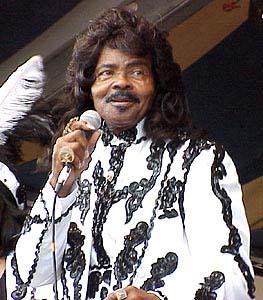
Ernie K-Doe (Born Ernest Kador) February 22, 1936 – July 5, 2001
New Orleans born, Ernie K-Doe was best known for his huge #1 hit, “Mother-In-Law,” released in 1961. A colorful performer, K-Doe was a popular draw in and around Louisiana for many years. During the ’80s, K-Doe hosted a popular New Orleans radio program. Ernie K-Doe passed away in 1989 at the age of 65.
Early Mardi Gras morning, Antoinette K-Doe passed away after a heart attack. Since editor Alex Rawls wrote about Antoinette and the Mother-in-Law Lounge in our January issue, we felt we’d already said much of what we wanted to say about her. Last issue, she spoke for herself, talking about cooking and being neighborly, so we decided to let some of the people who were touched by Antoinette share their recollections. We’ll miss her.—ED
The Wild Magnolias' Bo Dollis and Monk Boudreaux reunite, however briefly
Keith Spera / The Times-Picayune
Saturday's reunion of Bo Dollis and Monk Boudreaux at the Mid-City Lanes said as much about the future of the Wild Magnolias as the past.
Friends since childhood, Boudreaux and Dollis grew up to lead rival Mardi Gras Indian "gangs." They joined forces to front the Wild Magnolias electric funk band, whose 1974 debut introduced Mardi Gras Indian music to the world. On the likes of "Handa Wanda" and "Smoke My Peace Pipe," Boudreaux's more traditional chants offset Dollis' glorious rasp.
On a decidely more upbeat note, friend of no notes Mr. Fine Wine turns over an entire one-hour episode of his Downtown Soulville show to the music of the recently departed New Orleans legend Eddie Bo. Check it out here.
Nick Spitzer interview with Eddie from November 2nd, 2005
From the award-winning documentary, "Playing For Change: Peace Through Music". This film features many New Orleans artists including Grandpa Elliot, Washboard Chaz and my dear friend Roberto Luti (who's featured on the Heaven She Rides album by Sol Fiya). Be sure to check out the Playing For Change foundation and please show them some love.
Even if the Dirty Dozen Brass Band is not doing anything special to celebrate the 25th anniversary of its first release, My Feet Can't Fail Me Now, the album still marks some of the elements that have propelled the band through more than three decades together: dedication to practice and trying new things.
"In the beginning, we came together to learn music," Gregory Davis says. "There weren't any gigs. They were rehearsals."
The group included Roger Lewis and Charles Joseph, who were students at Southern University. Joseph brought his younger brother Kirk to play sousaphone. Davis was a student at St. Augustine High School. Drummer Benny Jones was in a band and had some connections to get gigs with social aid and pleasure clubs. The members agreed to work on any type of music.
With "New Orleans Meets Harlem," pianist Marcus Roberts explores the connections between two of jazz music's most elemental tributaries -- building on familiar ideas put in place by Jelly Roll Morton, Fats Waller, Scott Joplin, Duke Ellington and Thelonious Monk. The record, Roberts' first in eight years, hits the streets on Tuesday, March 31, and features bassist Roland Guerin and drummer Jason Marsalis. Good news: Keen and welcome touches of modernity keep this J-Master Records release from gathering the expected dust.
Voodoo blues man Papa Mali grew up in rural Louisiana where he soaked in everything from hill country guitar to the nearby Big Easy brass. He paid his dues in the clubs of New Orleans for more than two decades, but now the diversely skilled guitarist, whose real name is Malcolm Welbourne, tours around the country with his original brand of psychedelic Crescent City-inspired funk, mixing it up regularly in the world of jam and jazz. His latest album, 2007's “Do Your Thing,” was produced by Dan Prothero for Fog City Records and features collaborations with Kirk Joseph, Henry Butler, Big Chief Monk Boudreaux, Victoria Williams and JJ Grey.
Question: What types of music did you learn growing up in Louisiana?
Answer: From a pretty early age I was steeped in real Delta blues, soul and funk. There's two different schools in that type of music: the guys who grew up on a plantation in Mississippi, and then there are guys like me who are more like musicologists, honest about where they come from. Dr. John is one of my biggest heroes. At an early age he got over the whole trauma of race and color barriers that a lot of musicians go through. I was the same way. As a teenager I was playing with some cats that were the real deal, and they accepted me. They let me know that it was all about the music, and if you're sincere in the way that you portray it, you will be accepted. That's helped me to know my place in how I want to carry the music forward.
It is one of those unintended confluences that Joan Selects, Volume 18 - Joan's Jazz Fest Special appears just several weeks from the start of the 40th annual New Orleans Jazz and Heritage Festival: www.nojazzfest.com. You can thank your blog host for the great timing for this post.
All the music in Joan Selects - Volume 18, emanates from the musical gold-mine that is New Orleans. In fact most all the selections here-in presented were recorded at the legendary J & M recording studios under the astute and gifted direction of Cosimo Matassa.
Almost everyone who plays jazz clarinet in a classic style can trace their musical lineage back to the Tio family, a dynasty of clarinet masters from New Orleans¹ Creole seventh ward. In the early 1900s, they taught the first generation of jazz players the value of using classical techniques. Evan Christopher continues the legacy.
The Tio family was a dynasty of clarinet masters from New Orleans' Creole seventh ward. In the early days of the 20th century, they taught a first generation of jazz players the value of using classical techniques in their playing. The Tios were all professional musicians on the active New Orleans music scene where they worked as composers, arrangers, and conductors in brass bands, theater orchestras and 'society' dance bands. But most importantly, every afternoon there would be a steady stream of music students through their homes.
Ideal vision, we are told, is 20-20 and as we present our 20th class of Jazz-All Stars we see two decades of greatness and a talent pool that hasn’t been diminished. As always we present our All-Stars as two complete but non-existent bands – one traditional, the other contemporary. Selections are based from among those performers who continue to live and work mostly in this area. It is great to see such a promising list, and even better to hear.
The history of brewing in New Orleans is as cloudy as an unfiltered ale, little known outside its confines. Once a regional beer capital, it turned out a slew of popular brands like Falstaff, Jax, Regal and Dixie.
Now there are only a handful of breweries in the area, including Abita, Heiner Brau and a newcomer named NOLA Brewing Company. The good news is that over a well-hopped weekend you can sample all the local brews, tour their birthplaces and learn the story of the once — and possibly future — beer town of the South. The local brewing scene is concentrated these days in suburban St. Tammany Parish, on the north shore of the vast Lake Pontchartrain opposite the Big Easy. So that’s where I headed one morning, with an old college buddy along as designated driver, flitting over the brown lake like a water spider on the seemingly endless causeway.
As a city that treasures its musical heritage, New Orleans is probably second only to Nashville.
I’ve been listening to WWOZ in recent weeks. WWOZ is a free- form community radio station that’s become a linchpin of the New Orleans music scene.
WWOZ rocks ass. Below are just a few recordings to which I’ve been introduced by ’OZ’s dedicated volunteer deejays. Click the track titles to listen on my Vox blog.
There’s a lot going on during the French Quarter Festival, and it takes a big brain to keep track of it all. OffBeat wants you to be that big brain, so here’s our guide to all the jazz, blues, Cajun, zydeco, funk, soul and rock ’n’ roll that takes place on 17 stages arranged in the French Quarter between Bourbon Street and the Mississippi River. Pay attention—there will be a quiz.
Most bands would be envious of the subdudes’ lot in life. After all, many struggle and fail in their bids to reach the top of the mountain once, let alone twice. Although the subdudes suffered an acrimonious breakup that lasted for six years, the group has spent its time, since its reunion in 2002, re-establishing itself within a marketplace that has grown considerably more crowded. Its latest set Live at the Rams’ Head combined with its complementary documentary Unplugged at Pleasant Plains couldn’t have been issued at a better time, either.
I first listened to this CD on a Sunday morning. It was quite early, and I had just gone to a hockey game the night before, so the sport was still on my mind. As the CDs first track opened up, it immediately got me thinking about partying. I quipped to myself, “I went to a party and an Eric Lindell concert broke out,” and it hit me; I’ve bent the joking phrase, “I went to a fight and a hockey game broke out,” around, but it fits so nicely. Seeing Eric live or even listening to him on a CD makes you feel like having you’re having a party.