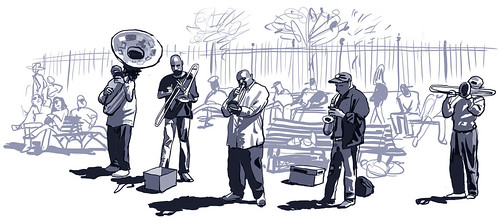
Last year, the New Orleans Jazz and Heritage Festival presented by Shell generated an estimated $300 million in economic impact for the city of New Orleans and the surrounding metropolitan area. An estimated 400,000 people attended the event over seven days in 2009. It wasn't always so.
The festival did not even break even financially in the early days and anecdotal evidence suggests that there were more musicians than music lovers at the first event, held in Beauregard Square (now Congo Square), in 1970. There were several aborted attempts to create a jazz festival in New Orleans in the late 1960s. The Newport Jazz Festival was the template, but there were also two other festivals of significance, one in Monterey, California in 1968 and the more famous event in Woodstock, New York in August of 1969, that helped define the concept of an outdoor music festival.
To finish the evening, I made my way back to the Louis-Louis pavilion to catch the full on brass fury of Bonerama. But to my surprise, Susan Cowsill had since enlisted the help of Bone’s Craig Klein and was busy throwing a party of her own. Before long Bonerama stepped to the sage, closing out FQF with a hard rocking, funky heavy set of balls out brass. Anchored by the trombone squalls of Mark Mullins, Craig Klein and Greg Hicks, the Bones have recently enlisted the services of organist Joe Ashlar to fill the void left in the wake of trombonist Steve Suter’s departure from the group. Though one trombone light, they still brought the heat, and with Ashlar’s churning keys stirring the mix, their jams flowed deep into the funky vortex as the sun set behind them. And that just about wraps it up for French Quarter Fest 2009 – Talkin’ bout New Orleans, ya head!
A scientist friend of mine once told me about a study he came across on pedestrian power and who gives up the right of way on the sidewalk. He said in this study, no one moved out of the way of immigrants. Generally people moved over for little kids, black men, white men, disabled people. The one group EVERYBODY moved out of the way of...
We started playing around the city like [marching bands]. We didn’t have cars. We weren’t big. After a while, some guys from another brass band and two of us got together and formed what became Hot 8.” The band remained relatively unknown until after the events following Hurricane Katrina.
RR: There’s so many textures and colors on Piety Street: gospel, New Orleans jazz, blues, funk, sublayers of American jazz, classic rock ‘n’ roll, and I’d love to talk about the musicians that you gathered together for this project. There is strong chemistry with these collaborators starting right off with George Porter, Jr. on bass.
JS: Well, you know, when I decided to go to New Orleans, and wanted to record with New Orleans musicians, and have my music reflect the New Orleans tradition, he was the first person that I thought of for electric bass, for sure, because he’s made so many great records, been on the Meters side, and, also, all of the Allen Toussaint productions, and music that I was a fan of music coming out of that city. He’s legendary, and he sure does a great job. Man, he’s totally a great musician, covers his stuff, and brings his groove to it, and we just had a wonderful time playing together.
RR: Jon Cleary sure matches up quite well with your guitar playing.
JS: Oh, thanks. I’ve been a big fan of Cleary’s. I think I met him about 18 years ago. He blew me away then, and still does now. When I was thinking that we should do these gospel tunes, and really have vocals, I mean, I just love his vocal interpretations—the way he can phrase. He’s one of the great soul singers of our day, really. His piano playing is phenomenal. I knew he would be perfect for this. I was really lucky to get him. I feel like he’s the star of the album.
“Tuts” was another New Orleans Piano legend. Born January 24, 1907 in New Orleans he started to teach himself how to play piano at age 10 and then studied with New Orleans jazz pianist Joseph Louis “Red” Cayou. He played with many jazz and Dixieland groups through the 20s and 30s. Hos keyboard style blended elements of ragtime, jazz, blues and boogie-woogie.
After living and playing in Saint Louis for many years he returned to New Orleans and in his later years he became a staple at the lounge of the Pontchartrain Hotel on the corner of St. Charles and Jackson Avenues on the edge of the Garden District.
You walk around a corner and in a parking lot on a Sunday afternoon, you can stumble on more music than most cities produce in a year. Glen David Andrews hosts an open percussion jam session with friends.
Enter to win 2 tickets to a wonderful day at the 40th Anniversary New Orleans Jazz & Heritage Festival presented by Shell. Visit www.nojazzfest.com for the daily lineup and more information.
Deacon John Moore hasn’t just seen five decades of New Orleans music history, he’s lived them. A singer-guitarist, band leader, session musician, solo recording artist and occasional TV star, Moore continues to be a prominent player in his hometown’s music scene. Recent accomplishments include his 2006 election as the first African-American president of the local musicians union and a starring role in the music documentary, Going Back To New Orleans. Three days before the national broadcast of Going Back To New Orleans on Aug. 29, 2007, Hurricane Katrina’s second anniversary, Moore drew news coverage when he and other New Orleans musicians marched in a silent second line from Louis Armstrong Park to the French Quarter.
NICK DERISO: Benny Spellman's "Fortune Teller," a witty early-1960s story song, is one of my touchstone party records.Everything about it is perfectly New Orleans, from the pounding piano to this sizzling island-tinged percussion, from a group of yelping, mesmerizingly groovy R&B backup singers to its not one but two gotcha lyrics.Spellman, see, goes to a fortune teller only to be stunned with the news that he's fallen for someone. Problem: Spellman's not seeing anybody. She counters: "When the next sun rises, you'll be looking in her eyes."Morning comes, and nothing. Spellman rushes back to the fortune teller, "mad as I could be. ... Why'd she make a fool of me?" When he gets there, though, the truth blooms before his very eyes: "While looking at the fortune teller, I fell in love!"
Scofield wanted to make a blues album, but that idea soon evolved into making a gospel record. It evolved further into making a gospel record with a New Orleans flavor. Named after the famed NOLA studio it was recorded in, Piety Street, released last week, marks another surprisingly successful sharp directional change for this most malleable of guitarists.
For this project, Steve Swallow and Bill Stewart just weren't going to do, as good as they are. Scofield assembled a whole new band perfectly suited for this kind of music: legendary ex-Meters bassist George Porter, Jr., the British-born Bonnie Raitt keyboardist Jon Cleary, Raitt's longtime drummer Ricky Fataar, New Orleans vocalist John Boutté (vocals), and another New Orleans musician, drummer/percussionist Shannon Powell from Harry Connick, Jr.'s band.Neither gospel nor New Orleans R&B is new to Scofield's repertoire; "Heaven Hill" is a church-inspired number he wrote for Blue Matter way back in 1986, and he did a great cover of the Meters' "Sissy Strut" on Flat Out two years later. For Piety Street, though, the plunge is with both feet in. This ain't no "gospel-tinged" music, folks, it's gospel.
New Orleans could get a proper prime-time spotlight with David Simon's TremÉ, whose pilot shoot wrapped earlier this month. Now all HBO needs to say is 'go.'
As March in New Orleans was coming to a close, another march in Central City was just getting started. Two children snaked through the ranks of the Treme Brass Band, whose second line trumpeted a horse-drawn hearse. With fans and umbrellas held high, moving to the half-speed strains of "Just a Closer Walk With Thee," the group half-stepped past the Payne Memorial Church on Liberty Street, taking a wide left turn onto Toledano Street. And as the song neared its apex, a cry rang out from behind Uncle Lionel Batiste's thumping bass drum.
"Cut!"
Except they didn't. The parade, now halfway down the block, continued on toward LaSalle Street. "Someone stop them," said director Agnieszka Holland. Slowly, like an old phonograph winding down, the music petered out as the players caught on, gradually reversing course and shuffling back to their original spots for a second take.
It was the final hours of filming for Tremé, the pilot episode of David Simon's prospective HBO drama, and already the show had run up against questions of realism — i.e., it was due to wrap almost on schedule. Despite threats of rain and hail, the planned 17-day shoot finished on April 2 with a scene at The Times-Picayune's Howard Street offices.
April 17th, 2009 marked the kickoff of the 26th annual French Quarter Fest. As the workweek wound down, I listed along with WWOZ’s live broadcast, anxiously racing down to the French Quarter, hoping to catch the tail end of the Honey Island Swamp Band’s set. That unfortunately didn’t happen, but I did arrive in time to hear the powerhouse wail of Irene Sage rip through a cover of Led Zeppelin’s “Ramble On." It’s always a treat to see Sage, whose presence in the scene has declined over the years. Her husky, unhinged vocals always bring about a good time. She’s the closest thing the Big Easy has to Ann Wilson, and her thunderous closer at FQF, “Soul to Soul,” certainly solidified that comparison.
Made to the second day of French Quarter Fest (April 18, 2009) right as Ingrid Lucia began her set at the Esplanade in the Shade stage. Joining the bubbly jazz vocalists were trombonist Mark Mullins (Bonerama), guitarist John Fohl (Dr. John) and drummer Simon Lott – quite the allstar cast! This staggering gang certainly did not disappoint. Mullins’ trombone bellowed along with Lott’s jazzabilly rumble, and Fohl’s dangling guitar rides swept up Lucia’s delicious vocals. Enchanting and indelible, Lucia is one brightest talents in the Big Easy. And nothing compares to spending a sunny day with her sweet croon.
About the only person not moving as the Hot Club of New Orleans swung out Saturday afternoon on a spry set of hot jazz on the steps of the Louisiana Supreme Court building was Chief Justice Edward Douglas White. But he had an excuse: He's a bronze statue.
Bo Dollis, leader of the Wild Magnolias, is fighting his way back.
Through grave illness. A rupture with a manager he once trusted. A years-long professional estrangement from Monk Boudreaux, his childhood friend and partner in the Wild Magnolias.
Through it all, his pride remains undiminished, his voice -- one of the most potent in all of New Orleans music -- strong.
The New Orleans Jazz & Heritage Festival celebrates its 40th anniversary
Photo by Cheryl Gerber
I
t's been four decades since the first New Orleans Jazz & Heritage Festival kicked off in Congo Square in Armstrong Park. The festival has grown exponentially since then, now filling 12 stages and two long weekends at the Fair Grounds. Every day features hundreds of musicians, some traveling from faraway spots around the globe.
One of the featured performances this weekend highlights the heritage of New Orleans music. Wynton Marsalis returns to his hometown with the Jazz at Lincoln Center Orchestra and Ghanian musician Yacub Addy and his Odadaa! band to perform Congo Square, a modern jazz suite uniting musicians from two continents to celebrate common musical roots.
Take a guitar player from the rhythm and blues pinnacle of the 1950s, sprinkle in the styles of a smattering of influential blues guitarists, overlay funk rhythms, and a uniquely soulful vocal style, and the sum total is Walter “Wolfman” Washington – a staple musician of the New Orleans scene for more than a half of a century.
If you live in New Orleans, you should probably know Frenchy by now. He’s a performance painter and while most nights he is found at the Maple Leaf, he also paints at Tipitina’s, Saints and Hornets games, most local festivals, and anywhere he can find excitement and inspiration. Most of his paintings are done in bold, vibrant colors and they are so full of energy that they seem to have a life of their own.
French Quarter Fest is one of the must-see music festivals in New Orleans. It's the largest free music festival in the entire South, with around 435,000 attendees last year. For 2009, FQF will encompass 18 stages and over 450 performers, with 250 hours of music!
WWOZ will broadcast many of these performances — from jazz and funk to roots and reggae — live from the new Southern Comfort "Esplanade in the Shade" stage at the Old U.S. Mint, so check out our broadcast schedule below and don't miss this amazing weekend of live New Orleans music!
Live Broadcast Schedule
FRIDAY, APRIL 17
1:00 - 2:15 p.m.
Soul Project
2:30 - 3:45 p.m.
Honey Island Swamp Band
4:00 - 5:30 p.m.
Da Posse featuring Kevin O’Day, Reggie Scanlan, and Dave Malone
SATURDAY, APRIL 18
11:15 a.m. - 12:45 p.m.
The Revealers
4:00 - 5:30 p.m.
Ingrid Lucia
5:45 - 7:00 p.m.
Astral Project
SUNDAY, APRIL 19
11:15 a.m. - 12:45 p.m.
The Creole Stringbeans
1:00 - 2:15 p.m.
Tony Green & Gypsy Jazz
2:30 - 3:45 p.m.
Los Poboycitos
4:00 - 5:30 p.m.
E.O.E.
5:45 - 7:00 p.m.
Big Chief Bo Dollis Jr. & the Wild Magnolias
For more information and the complete schedule of performances and other new stage locations, visit the French Quarter Festival website, or go straight to the music schedule, where you can create your own customized schedule to print out.
The French Quarter Festival is produced by French Quarter Festivals, Inc., a nonprofit organization that also produces Satchmo SummerFest in August and Christmas New Orleans Style in December.
Early Mardi Gras morning, Antoinette K-Doe passed away after a heart attack. Since editor Alex Rawls wrote about Antoinette and the Mother-in-Law Lounge in our January issue, we felt we’d already said much of what we wanted to say about her. Last issue, she spoke for herself, talking about cooking and being neighborly, so we decided to let some of the people who were touched by Antoinette share their recollections. We’ll miss her.—ED
The Wild Magnolias' Bo Dollis and Monk Boudreaux reunite, however briefly
Keith Spera / The Times-Picayune
Saturday's reunion of Bo Dollis and Monk Boudreaux at the Mid-City Lanes said as much about the future of the Wild Magnolias as the past.
Friends since childhood, Boudreaux and Dollis grew up to lead rival Mardi Gras Indian "gangs." They joined forces to front the Wild Magnolias electric funk band, whose 1974 debut introduced Mardi Gras Indian music to the world. On the likes of "Handa Wanda" and "Smoke My Peace Pipe," Boudreaux's more traditional chants offset Dollis' glorious rasp.
On a decidely more upbeat note, friend of no notes Mr. Fine Wine turns over an entire one-hour episode of his Downtown Soulville show to the music of the recently departed New Orleans legend Eddie Bo. Check it out here.
Nick Spitzer interview with Eddie from November 2nd, 2005
From the award-winning documentary, "Playing For Change: Peace Through Music". This film features many New Orleans artists including Grandpa Elliot, Washboard Chaz and my dear friend Roberto Luti (who's featured on the Heaven She Rides album by Sol Fiya). Be sure to check out the Playing For Change foundation and please show them some love.
Even if the Dirty Dozen Brass Band is not doing anything special to celebrate the 25th anniversary of its first release, My Feet Can't Fail Me Now, the album still marks some of the elements that have propelled the band through more than three decades together: dedication to practice and trying new things.
"In the beginning, we came together to learn music," Gregory Davis says. "There weren't any gigs. They were rehearsals."
The group included Roger Lewis and Charles Joseph, who were students at Southern University. Joseph brought his younger brother Kirk to play sousaphone. Davis was a student at St. Augustine High School. Drummer Benny Jones was in a band and had some connections to get gigs with social aid and pleasure clubs. The members agreed to work on any type of music.
With "New Orleans Meets Harlem," pianist Marcus Roberts explores the connections between two of jazz music's most elemental tributaries -- building on familiar ideas put in place by Jelly Roll Morton, Fats Waller, Scott Joplin, Duke Ellington and Thelonious Monk. The record, Roberts' first in eight years, hits the streets on Tuesday, March 31, and features bassist Roland Guerin and drummer Jason Marsalis. Good news: Keen and welcome touches of modernity keep this J-Master Records release from gathering the expected dust.
Voodoo blues man Papa Mali grew up in rural Louisiana where he soaked in everything from hill country guitar to the nearby Big Easy brass. He paid his dues in the clubs of New Orleans for more than two decades, but now the diversely skilled guitarist, whose real name is Malcolm Welbourne, tours around the country with his original brand of psychedelic Crescent City-inspired funk, mixing it up regularly in the world of jam and jazz. His latest album, 2007's “Do Your Thing,” was produced by Dan Prothero for Fog City Records and features collaborations with Kirk Joseph, Henry Butler, Big Chief Monk Boudreaux, Victoria Williams and JJ Grey.
Question: What types of music did you learn growing up in Louisiana?
Answer: From a pretty early age I was steeped in real Delta blues, soul and funk. There's two different schools in that type of music: the guys who grew up on a plantation in Mississippi, and then there are guys like me who are more like musicologists, honest about where they come from. Dr. John is one of my biggest heroes. At an early age he got over the whole trauma of race and color barriers that a lot of musicians go through. I was the same way. As a teenager I was playing with some cats that were the real deal, and they accepted me. They let me know that it was all about the music, and if you're sincere in the way that you portray it, you will be accepted. That's helped me to know my place in how I want to carry the music forward.
It is one of those unintended confluences that Joan Selects, Volume 18 - Joan's Jazz Fest Special appears just several weeks from the start of the 40th annual New Orleans Jazz and Heritage Festival: www.nojazzfest.com. You can thank your blog host for the great timing for this post.
All the music in Joan Selects - Volume 18, emanates from the musical gold-mine that is New Orleans. In fact most all the selections here-in presented were recorded at the legendary J & M recording studios under the astute and gifted direction of Cosimo Matassa.
Almost everyone who plays jazz clarinet in a classic style can trace their musical lineage back to the Tio family, a dynasty of clarinet masters from New Orleans¹ Creole seventh ward. In the early 1900s, they taught the first generation of jazz players the value of using classical techniques. Evan Christopher continues the legacy.
The Tio family was a dynasty of clarinet masters from New Orleans' Creole seventh ward. In the early days of the 20th century, they taught a first generation of jazz players the value of using classical techniques in their playing. The Tios were all professional musicians on the active New Orleans music scene where they worked as composers, arrangers, and conductors in brass bands, theater orchestras and 'society' dance bands. But most importantly, every afternoon there would be a steady stream of music students through their homes.
Ideal vision, we are told, is 20-20 and as we present our 20th class of Jazz-All Stars we see two decades of greatness and a talent pool that hasn’t been diminished. As always we present our All-Stars as two complete but non-existent bands – one traditional, the other contemporary. Selections are based from among those performers who continue to live and work mostly in this area. It is great to see such a promising list, and even better to hear.
The history of brewing in New Orleans is as cloudy as an unfiltered ale, little known outside its confines. Once a regional beer capital, it turned out a slew of popular brands like Falstaff, Jax, Regal and Dixie.
Now there are only a handful of breweries in the area, including Abita, Heiner Brau and a newcomer named NOLA Brewing Company. The good news is that over a well-hopped weekend you can sample all the local brews, tour their birthplaces and learn the story of the once — and possibly future — beer town of the South. The local brewing scene is concentrated these days in suburban St. Tammany Parish, on the north shore of the vast Lake Pontchartrain opposite the Big Easy. So that’s where I headed one morning, with an old college buddy along as designated driver, flitting over the brown lake like a water spider on the seemingly endless causeway.
As a city that treasures its musical heritage, New Orleans is probably second only to Nashville.
I’ve been listening to WWOZ in recent weeks. WWOZ is a free- form community radio station that’s become a linchpin of the New Orleans music scene.
WWOZ rocks ass. Below are just a few recordings to which I’ve been introduced by ’OZ’s dedicated volunteer deejays. Click the track titles to listen on my Vox blog.
There’s a lot going on during the French Quarter Festival, and it takes a big brain to keep track of it all. OffBeat wants you to be that big brain, so here’s our guide to all the jazz, blues, Cajun, zydeco, funk, soul and rock ’n’ roll that takes place on 17 stages arranged in the French Quarter between Bourbon Street and the Mississippi River. Pay attention—there will be a quiz.
Most bands would be envious of the subdudes’ lot in life. After all, many struggle and fail in their bids to reach the top of the mountain once, let alone twice. Although the subdudes suffered an acrimonious breakup that lasted for six years, the group has spent its time, since its reunion in 2002, re-establishing itself within a marketplace that has grown considerably more crowded. Its latest set Live at the Rams’ Head combined with its complementary documentary Unplugged at Pleasant Plains couldn’t have been issued at a better time, either.
I first listened to this CD on a Sunday morning. It was quite early, and I had just gone to a hockey game the night before, so the sport was still on my mind. As the CDs first track opened up, it immediately got me thinking about partying. I quipped to myself, “I went to a party and an Eric Lindell concert broke out,” and it hit me; I’ve bent the joking phrase, “I went to a fight and a hockey game broke out,” around, but it fits so nicely. Seeing Eric live or even listening to him on a CD makes you feel like having you’re having a party.
 The first twenty years in retrospect


![[scofield1.jpg]](https://blogger.googleusercontent.com/img/b/R29vZ2xl/AVvXsEg282P-mAI_2x6S2bU6xS1F5Ln3rmM50B3viXQA4I5Wk8sbJ-Vr516pwffDZqhz9WQVFor27AN21jQLNDwJ61PGQuNtmY4f8M2GPDKy9sC0aK5sDvsXSa9JROXdW6Xe4KfmecFPYmk9E5Q/s1600/scofield1.jpg)