Just inside a room on the second floor of the Louisiana State
Museum's Presbytere, there's a large baby doll dress, big enough for a
woman to wear. And one did.
The costume and the baby bottle
next to it belonged to 85-year-old Miriam Batiste Reed, who was known as
a baby doll and one of the first women to parade in Mardi Gras. The
bottle and the dress are part of a new exhibition, They Call Me Baby Doll: A Mardi Gras Tradition.
"The
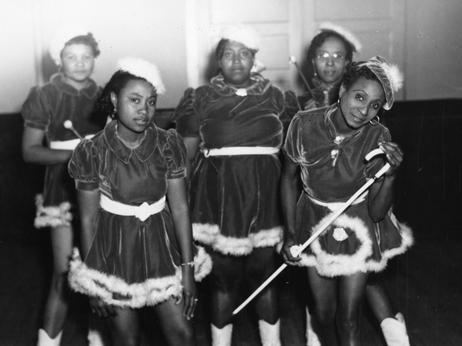
baby dolls are a group of African-American men and women carnival
maskers," says Kim Vaz, dean at Xavier University. "They would dress up
on Mardi Gras day in short satin skirts, with bloomers, and they would
have garters."
Vaz, who has written a new book about the baby
dolls, says the tradition dates back to 1912, when Jim Crow was the law
of the land in the South. It all started in New Orleans' red-light
district, which itself was divided along racial lines. The Storyville
area, where the sex industry was legal, was for white customers; black
customers had to go a few blocks away where prostitution was illegal,
but allowed.
"[It was] another manifestation of how Jim Crow worked to
disenfranchise black people, even in the most sordid of industries," Vaz
says.
Between these two red-light districts, there was a kind
of rivalry. One year the women in the black district heard that their
counterparts in Storyville were going to dress up for Mardi Gras; they
decided they needed to come up with some good costumes to compete. "And
they said, 'Let's just be baby dolls because that's what the men call
us. They call us baby dolls, and let's be red hot,' " Vaz says.
Calling
a woman "baby" had just made its way into the popular lexicon, with
songs like "Pretty Baby" written by New Orleans native Tony Jackson.
There was, however, something subversive about black sex workers
dressing this way. "At that time, baby dolls were very rare and
very hard to get," Vaz says. "So it had all that double meaning in it
because African-American women weren't considered precious and
doll-like."
Just the fact that these prostitutes were masking
and going out into the street at all was a big deal. Women just did not
do that then. And as sex workers, these women were already taboo. Vaz
says they just kept piling on by appropriating males behaviors like
smoking cigars and flinging money at the men. "If you went to touch their garter, they would hurt you," she says.
The
baby dolls carried walking sticks they would use in their dances, as
well as to defend themselves. It was about fun, Vaz says, but it was a
kind of laughter to keep from crying. "At that time ...
residential segregation was practiced, job discrimination was practiced
[and] women didn't have the right to vote," she says. "The one way that
they could make a statement was through their dance and their dress and
their song. It's when you've exhausted all your legal remedies that you
have to use the culture to make a statement and express yourself."
They
came up with their own dance step they called "walking raddy." Pretty
soon, women in more "respectable" neighborhoods started masking baby
doll. But desegregation in the 1950s allowed black New Orleanians to do
more on Mardi Gras. Then Interstate Highway 10 was built
directly through the neighborhood where African-Americans gathered to
celebrate carnival, disrupting many traditions. The baby dolls faded,
until several years ago.
Carnival season officially began on Twelfth Night, January 6. But for many, the real festivities kick off at Krewe du Vieux, the salacious, satirical first parade of the season, which reveled in ribaldry this past weekend. So, as they say – game on!
Every Tuesday from now until Mardi Gras Day, we’ll be posting a different Carnival classic here on NOLA.com.
To kick things off, here’s Al “Carnival Time” Johnson’s (king of Krewe
du Vieux 2005) wonderfully weird signature tune, first released in
1960.
Interestingly enough, when Ric Records first pressed the
single, it didn’t immediately become the Mardi Gras anthem it is today;
Minit Records’ latest release, Jessie Hill’s “Ooh Poo Pah Doo”
overshadowed it in sales and popularity.
“It’s Carnival Time” boasts a joyful and buoyant piano groove; it
also features some of the oddest lyrics to come out of New Orleans’
golden age of R&B, to wit: “The Green Room is smokin’ and the
Plaza’s burning down/throw my baby out the window and let the joint burn
down/ all because it’s Carnival time.”
The horn section boasted
an all-star cast, including Lee Allen and James Rivers; according to New
Orleans music historian Jeff Hannusch, Mac Rebennack (and not Al) plays
piano on the session that was eventually released.
“Ooh
Poo Pah Doo” may have won the day fifty years ago, and it remains one
of New Orleans’ finest (and also lyrically, strangest) R&B classics.
But you can’t keep a good song down, and if you don’t hear “It’s
Carnival Time” at least eight million times in the streets, clubs and
shop of New Orleans during January and February, well, you might need to
clean your ears.
Here's Al "Carnival Time" Johnson's new Super Bowl-specific version of his classic hit:
Well, it's way past time for more Carnival tunage up in here. TheHOTG webcastis streaming music of the season 24/7 through Mardi Gras Day, too. So, hit that anytime for more fun. But, right here, right now, I'm posting a track each from the Wild Magnolias and the Wild Tchoupitoulas for our holiday festivities; and, in between, we'll have intense, live Mardi Gras Indian-influenced funkitude from Professor Longhair, plus a pretty obscure seasonal groove offering that owes an obvious debt to Fess. So, prepare to loose that Who Dat! booty. It's Mardi Gras comin', y'all.
February 10th, 2010 ~ Come stir the pot with American Routes as we bring you a sampling of great live music from our home state: Louisiana. First we'll stop by the soon to be legendary BlackPot Festival in Lafayette for some new flavors of Cajun and Creole tunes, as well as some old favorites by special guests. Then we'll walk through the streets of New Orleans with the Prince of Wales Social Aid and Pleasure Club during their annual second line parade.
uffice it to say that the city of New Orleans is caught up in an unprecedented state of merriment. Tuesday, an estimated 800,000 people showed up at the Saints’ Super Bowl parade – a glorious occasion, if I might say so myself. Now, what can only be predicted to be the largest Mardi Gras celebration in history is just about to kick off. In keeping with the spirit of the season – and the brass band theme – I’ve got an OG lined up for today that’s sure set the weekend off right. My subject for this week’s column is Crescent City favorite, the Rebrith Brass Band.
“If you’re in here you’ve got to be willing to work,” he said. “One slip of the tongue, that’s one less person. One slip of the hand, that’s one less person. We need everybody.”
In the cramped band room of the West Bank charter school, that “everybody” is more than 100 students strong. It includes novices who only recently picked up an instrument and students with so much musical experience their horns feel like extensions of their hands.
Such large, ambitious marching bands have become a relative anomaly in a city famous for its second-lines, brass bands and musical luminaries, however. More than four years after Hurricane Katrina, band leaders say they are fighting to ensure the tradition thrives in a dramatically altered public school landscape.
The decline of that tradition, they fear, would mark the loss of an activity — a passion — that, over the decades, has kept scores of the city’s teenagers connected to school. The best band directors realize that strong marching bands can bolster strong academic programs in the long run, particularly if the music and academic classes are well integrated. And in some cases, “if you keep an instrument in a kid’s hand, it will keep a kid from picking up a gun,” said Elijah Brimmer, a longtime band director in the city.
Art Neville was the keyboardist and a singer for the Meters, one of the most influential bands in American-music history—and quite possibly the greatest funk band of all time. Later on, his youngest brother, Cyril, joined the group as a percussionist and vocalist. Something must’ve clicked because when the Meters broke up in the late ’70s, Art and Cyril, along with their other brothers, Charles (sax) and Aaron (singer), formed the Neville Brothers. With their delicate harmonies and predilection for funk, they became one of the top purveyors of the NOLA sound.
Mac Rebennack was born in New Orleans in 1940. His musical career, as a guitarist, took off in the late ’50s. But following an accident, he had to drop the guitar, so he focused on playing the bass and then, with Professor Longhair as an important influence, turned to the piano. Several years later, in the early ’60s, Mac Rebennack moved from LA to L.A. and somewhere along the way, with time and the help of his winning combination of blues, jazz, pop, boogie-woogie and Zydeco, the singer-songwriter was reborn as Dr. John. His live shows, known for R&B, psychedelic rock and a little a bit of voodoo hoodoo, earned him a cult following—and the attention of Eric Clapton and Mick Jagger. Ultimately, though, he’ll probably always be known for the albums Gris-Gris, Dr. John’s Gumbo, In the Right Place and Desitively Bonnaroo (a name music-festival fans might recognize).
And the best news of all is that both the Neville Brothers and Dr. John (above, playing “Iko Iko”) are playing The Wellmont Theatre tomorrow night, and The House List is giving away two tickets. Want to go? Then fill out the form below, listing your name, e-mail address, which show you’re trying to win tickets to (Nevilles/Dr. John, 2/13) and a brief message telling us what you love about New Orleans music. The winner will be notified later today.
HMBB! is proud to be playing Michael Arnone’s Mardi Gras Party at Mexicali Blues in Teaneck, NJ on Sat Feb 13th Also… Monday, Feb 15th we’re at Fat Cat and MARDI GRAS day we’ll be rocking Union Hall in Park Slope.
UNION HALL'S FAT TUESDAY PARTY!
featuring performances from
THE HIGH AND MIGHTY BRASS BAND
plus, also, too
ROYAL AMERICAN SOCIAL AID & PLEASURE CLUB
featuring jambalaya, hurricanes, DJs, $3 pints of Abita, and much much more - costumes encouraged! Come celebrate Mardi Gras at Union Hall!
WWOZ's live broadcasts take you to local festivals, clubs, churches and the very streets of New Orleans. We also broadcast live from music festivals and other special performances across the U.S. and around the world. Schedule is subject to change.
The Louisiana Campaign for Tobacco-Free Living is sponsoring a series of 12 live broadcasts aimed at providing smoke-free environments for live music fans, musicians, and service staff.
WWOZ returns to our old neighborhood, the Tremé, to broadcast the Treme Brass Band live from the group's weekly gig at Candlelight Bar. The 45-minute broadcast will be hosted by 'OZ deejay A.A.
The Treme Brass Band is led by snare drummer Benny Jones, Sr., who founded the group in the mid 1990s after playing with the Olympia Brass Band and leading the Dirty Dozen and Chosen Few Brass Bands.
Although their music is steeped in the roots of New Orleans jazz, this multi-generational ensemble infuses it with a fresh exuberance that mixes in elements of funk, soul, and modern jazz.
Don't miss out on this very special live broadcast sponsored by the Louisiana Campaign for Tobacco-Free Living! For more info, please visit letsbetotallyclear.org.
WWOZ is teaming up with the Grammy Awards for a live broadcast of "A Night of Louisiana Music" from the Grammy Museum in Los Angeles on January 30 at 11pm CST.
This live broadcast is sponsored by the Convention and Visitors Bureaus of Louisiana, through the courtesy of Republic Beverage. The event will also be broadcast live on several affiliated public radio stations in California.
Stay tuned to our Live Broadcast page for details on which artists we'll be broadcasting.
In addition to being a founding member of Los Hombres Calientes with Irvin Mayfield and a member of Herbie Hancock's Headhunters, percussionist Bill Summers has worked with Quincy Jones on the musical score for Roots and the soundtrack to The Color Purple. Summers plays anything from traditional African instruments to pop bottles, bringing diverse people and ideas together.
Summers will perform with his latest band, Jazalsa, live in the WWOZ performance studio on Wednesday, February 3, during the New Orleans Music Show with George Ingmire.
WWOZ takes it back to the streets of New Orleans during Carnival time: We will broadcast live from several nighttime parades in the Uptown section of the Crescent City in the weeks before Mardi Gras (February 16).
WWOZ will bring Mardi Gras 2010 — from high-steppin' high-school marching bands playing the greatest Carnival music classics to on-the-street commentary from parading partiers — live to you wherever you are!
Stay tuned to this page for details about which parades 'OZ will be broadcasting, and check out our Mardi Gras page for items like the complete 2010 parade schedule and much more.
Antoinette K-Doe's funeral procession on Saturday included the mannequin of her late husband, Ernie K-Doe, which rode in a mule-drawn carriage.
In her final appearance, Antoinette K-Doe sold out St. James Methodist Church.
By the start of Mrs. K-Doe's funeral service Saturday morning, the neighborhood church on Ursulines Avenue had exceeded its standing-room-only capacity. A police officer turned away late arrivals, who pooled on the sidewalk to await the subsequent second-line.
Mrs. K-Doe, the widow of New Orleans rhythm & blues singer Ernie K-Doe and his equal in the annals of eccentricity, died of a heart attack early Mardi Gras morning.
Antoinette K-Doe, the widow of New Orleans music legend Ernie K-Doe, died Tuesday of a heart attack. In 2006, Josh Levin wrote about Ernie's run for New Orleans mayor from beyond the grave, Antoinette's return to New Orleans after Hurricane Katrina, and her hopes of reopening the Mother-In-Law Lounge—the bar and music venue bearing the name of her late husband's famous song. (The Mother-In-Law Lounge did reopen later in 2006 to much jubilation.) The original article is reprinted below.
Even by New Orleans standards, the jazz funeral for Lloyd Washington was a singular event. First, there was the date: Oct. 24, 2004, or four months after Washington, a singer and member of the final Ink Spots lineup, succumbed to cancer at 83. (Unable to provide a proper burial for her husband, Hazel Washington had kept his ashes safe in a small urn enshrined at the Ernie K-Doe Mother-in-Law Lounge on Claiborne Avenue.)
Second, there was the setting: the Musicians' Tomb at St. Louis Cemetery No. 1, a space in the Barbarin family mausoleum specially designated for local artists and their spouses. In a colorful procession that included two comrades' vehicles, Antoinette K-Doe's pink limousine and Geannie Thomas' red pickup truck, one of the last survivors of the legendary R&B group became the first musician laid to rest in the historic tomb.
Here's the video debut of New Orleans funksters Bonerama. This video for Big Fine Woman comes from PartyGras2009.com - a site anchored by PBS and Bonerama that will feature new music in the form of live shows, a single of a brand new song, or an archival release from back in the day every Tuesday in 2009…
Exclusive track – available from Tues 24th Feb for one week only!
Tuesday 24th February 2009 is Mardi Gras, and to celebrate, we’ve got an exclusive cut from Hot 8 Brass Band to give away absolutely FREE. Appropriately entitled “Steamin’ Blues”, this track is only available for one week, so click here to download this amazing joint from New Orleans’ finest, and get into the Mardi Gras spirit.
The history of musicians dealing with the storm's aftermath has been a mixed one. In the year after Katrina, benefits around the country helped musicians get home, get instruments, and get back to work. Then again, at Voodoo 2006, Duran Duran's Simon LeBon fretted from the stage over the devastation he saw on the drive from the airport — a corridor that looked more or less as it had pre-storm — and Wayne Coyne stopped the Flaming Lips' set to instruct New Orleanians on the importance of helping each other, perhaps mowing each others' lawns. Then and now, unmown lawns have been the least of the city's worries.
The VOODOO EXPERIENCE will return to Halloween weekend this October 30, 31 and November 1 in New Orleans’ City Park. This marks the third VOODOO EXPERIENCE that will coincide exactly with the Halloween weekend in a city that is as known for its magic as much as it is for its music.
(A quote from Pete Fountain years ago in an interview with New Orleans journalist Rosemary James.)
And so it has always been, with every Mardi Gras being the one that is the favorite in your mind, tops in your memory. And so it is this year. Some impressions;
Many years ago I lived in Brazil. And no matter how much acai or cafezinhos or palm oil I consumed, I could never ever keep up with my Brazilian friends and their partying - and I didn't even have a job during that time. I came to the realization at that point that to live in Brazil, one must develop Brazilian party muscles. This means learning how to survive on little to no sleep in pursuit of the party, knowing all hangover cures and at what point to activate which one, and attending each and every important celebratory function because, God forbid, folks raise the subject of 'that parade' or 'that party' and you can't add to the conversation because you weren't there.
Antoinette K-Doe, the irrepressible widow of rhythm & blues singer Ernie K-Doe who transformed the Mother-in-Law Lounge into a living shrine and community center, died early Tuesday after suffering a massive heart attack. She was 66.
"It was her personal mission to keep his memory alive," said Ben Sandmel, who is writing a biography of Ernie K-Doe. "But she also did so much for the community. It's a huge loss for the whole musicians' community of New Orleans."
Born Antoinette Dorsey, Mrs. K-Doe was a cousin of rhythm & blues singer Lee Dorsey. She had known Ernie K-Doe for many years before they became a couple around 1990.
At the time, the singer's best days were far behind him. After a string of hits in the early 1960s, most notably "Mother-in-Law," his career, and life bottomed out. By sheer force of will, she helped him return to the stage and transform himself into an icon of eclectic New Orleans. The couple married in 1994.
"She had him on a short leash," Sandmel said. "She cleaned him up and opened the lounge to give him a place to play."
Ernie K-Doe died in 2001. But thanks to his wife, he maintained a schedule of public appearances via a life-size, fully costumed, look-alike mannequin. Mrs. K-Doe referred to the mannequin as "Ernie."
As the mother hen of the Mother-in-Law Lounge, she presided over one of the city's most diverse, funky-but-chic watering holes. With its vibrant, larger-than-life exterior murals and adjoining gardens, the Lounge stood out on an otherwise rough stretch of North Claiborne Avenue.
As the Ernie mannequin looked on from its corner throne, Mrs. K-Doe served a mix of neighborhood regulars and hipsters from across the city. The Lounge was a favorite haunt of such non-traditional musicians as Mr. Quintron, the Bywater avant-garde keyboardist, inventor and marching band impresario.
The Lounge badly flooded in the wake of Hurricane Katrina's levee breaches. In advance of the floodwaters, Mrs. K-Doe dismantled the mannequin, stored the pieces in plastic bags, and stowed them in an upstairs closet. In the months after the storm, she revived the Lounge with the aid of an army of volunteers and financial support from contemporary R&B star Usher.
Mrs. K-Doe suffered a minor heart attack during Mardi Gras 2008, but recovered. On Thursday, she rode in the Muses parade with the Ernie mannequin. She served as the honorary queen of the Cameltoe Ladysteppers marching organization.
Today she had planned to don the traditional Baby Doll costume and parade through the streets of Treme before returning to the lounge for what is always a busy day. She helped revive the tradition of the Baby Dolls marching organization, and was happy to see others take up the mantle.
Michelle Longino, a founder of the Bayou Steppers Social Aid and Pleasure Club, received Mrs. K-Doe's blessing to costume as a Baby Doll and come out with Mardi Gras Indian Big Chief Monk Boudreaux on Mardi Gras morning.
"She told us that we needed to be proper Baby Dolls, not nasty Baby Dolls," Longino said. "Today we're going to call ourselves the Antoinette K-Doe Baby Dolls in her honor."
Around 3 a.m. Mardi Gras morning, Mrs. K-Doe awoke in her apartment above the Mother-in-Law Lounge and complained of feeling hot, said Gary Hughes, the husband of her adopted daughter, Jackie Coleman. She went downstairs and apparently suffered a heart attack on a sofa in the lounge.
Hughes, who was staying in the apartment at the time, said paramedics arrived quickly but could not revive Mrs. K-Doe.
Today's festivities at the Mother-in-Law Lounge will be in her honor.
"Mardi Gras was her holiday," Hughes said. "She loved Mardi Gras. We're going to run the lounge as if she was here and do it up this one last time for her."



 S
S


