Stooges Brass Band (memorial second line for Uncle Lionel)
Parade sets start at 6:30 at Josie Roberston Plaza
NY AREA- THERE WILL BE A MEMORIAL PARADE/2ND LINE TO HONOR UNCLE
LIONEL ON THURSDAY JULY 26TH AT 6:30- GATHER AT JOSIE ROBERTSON PLAZA AT
LINCOLN CENTER. THE PARADE WILL BE LED BY THE RED BULL STREET KINGS OF
NEW ORLEANS AKA THE STOOGES BRASS BAND. PLEASE COME OUT AND HONOR UNCLE,
BRING WHITE HANDKERCHIEFS, 2ND LINE UMBRELLAS, LARGE PICTURES OF UNCLE
IF YOU HAVE THEM, YOU ARE WELCOME TO ANY OF THE PICS ON MY PAGE- IF YOU
KNEW UNCLE, I KNOW YOU WILL BE THERE, IF YOU DIDN'T, BUT WANT TO
EXPERIENCE AN AUTHENTIC VERSION OF HOW NEW ORLEANS HONORS HER LOVED
ONES, COME OUT. IF YOU HAVE VIDEO SKILLS, PLEASE HELP US DOCUMENT SO WE
CAN SHOW THE FAMILY. PLEASE SHARE THIS WITH ALL YOUR FRIENDS AND LET'S
SHOW UNCLE HOW MUCH WE LOVE HIM. C'MON, ALL Y'ALL- BE IN DAT NUMBER- TO
BE FOLLOWED BY A FREE SHOW ON THE PLAZA BY THE STOOGES.
The drums could be heard first and then the
brass, and then, far down the street in the twilight, people could be
seen dancing and swaying, the bells of sousaphones above them like
halos. New Orleanians paraded in homage to Lionel Batiste, known to
everyone for decades as Uncle Lionel, to many simply as “Unc.”
NEW ORLEANS — The drums could be heard first and then the brass, and
then, far down the street in the twilight, people could be seen dancing
and swaying, the bells of sousaphones above them like halos. Shuffling
back and forth at the front of the parade was a paint horse named
Sunshine that somebody taught how to dance.
This was Day 2 of the party that has lasted over a week in the Treme
neighborhood. On some nights there have been small, informal parades
like this one; on other nights people from around the city and even
tourists have flocked to this neighborhood, New Orleans’s cultural and
musical heart, to see or be a part of a certain kind of celebration that
takes place almost nowhere else.
On the nights between the death and the burial of one of their
colleagues, musicians gather to play and remember. This culminates in
the funeral procession, one of those local traditions that is featured
in the city’s marketing materials but is no less old and true for it.
People still talk about processions from years past, but in terms of
size, the one coming up this Friday may be among the largest in recent
memory.
“The way things is going, this is probably going to be the biggest,”
said Action Jackson, a D.J. who follows cultural events for the local radio station WWOZ.
The man being laid to rest is Lionel Batiste,
known to everyone for decades as Uncle Lionel, to many simply as “Unc.”
Mr. Batiste, who was 80 when he died of cancer on July 8, was the
singer, bass drummer and assistant grand marshal for the Treme Brass
Band. He was also one of the great New Orleans personalities, the face of Treme and a consummate man about town.
"Uncle" Lionel Batiste, the Treme Brass Band’s longtime bass
drummer and a beloved, dapper character who reveled in charming women of
all ages on the dance floor, died early Sunday at Ochsner Baptist
Medical Center after a brief battle with cancer. He was 80.
Mr. Batiste was an iconic figure in the brass band community and the
larger world of New Orleans music. With his omnipresent sunglasses, a
wristwatch worn across his hand, and his kazoo, he literally moved to
the beat of his own drum.
The Congo Square Project is a volunteer organization dedicated to help New Orleans musicians in need via 6 albums/CD’s that trace the origin and development of the music that was brewed in the heart of the Crescent City. Some of the greatest talents in the world have donated their time and efforts to contribute and support the cradle of modern music. Threadhead Records is proud to help Mr. Fabian Jolivet get this music out to the world. Proceeds from the 4 recordings will benefit the New Orleans Musicians Clinic, the Congo Square Drummers Foundation, The Reverend Lois Dejean’s Youth Assistance Foundation and the Mardi Gras Indians Foundation.
The Congo Square Project contains a wealth of music. Starting in July 2010, and for each of 3-5 months thereafter, this website will release one CD per month from The Congo Square Project for download.
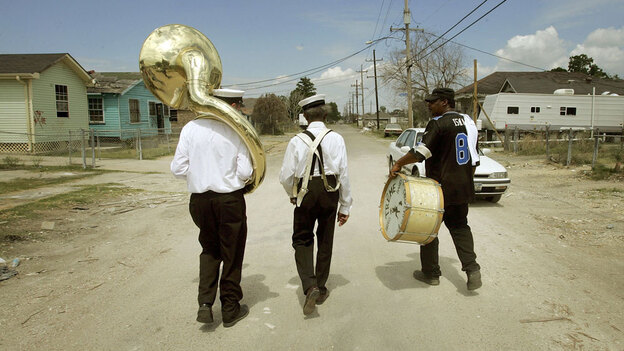
Members of the Treme Brass Band walk through the 9th Ward after attending a Memorial Day service honoring the victims of Hurricane Katrina in 2006.
The Treme Brass Band lives and breathes New Orleans traditions. The band often leads jazz funerals and "second line" street parades. They've been featured on the HBO series Treme and in Spike Lee’s documentaries about Hurricane Katrina.
Late Wednesday nights, you can find the band jamming at a down-home joint in New Orleans called the Candlelight Lounge. It's packed with new TV fans and loyal locals. "They fabulous, they wonderful," says Buster Andrews, 37. "Old Treme neighborhood band been around here all my life."
A funky mix of both seasoned and younger musicians rotate in and out of the band, led by 67-year-old snare drummer Benny Jones, Sr. His band has helped to keep alive a New Orleans brass band tradition that began at the turn of the last century. "Still need somebody to do the traditional music so we can pass that to the younger generation," says Jones. "Somebody got to hold that spot down."
That includes leading dancers through the streets to mourn and celebrate. The band stays rooted in the customs of an earlier era, such as a dress code. "Sound good, look good," says Jones. "My band always had the black pants, white shirts, ties, coats. That's a New Orleans tradition. What the older bands did years ago."
The Treme Brass Band has been a training ground for other musicians. Sam Williams, who now has his own funk band, says, "If you haven't played with the Treme, [you] don't know what's up."
Cool Uncle Lionel
Central to the band's popularity is the stylish bass drummer, Lionel Paul Batiste, Sr. "Uncle Lionel," as he's known, is never without his dark sunglasses, hat, two-tone shoes, gold watch and rings.
"Uncle's the man, know what I'm saying?" says Williams. "Just a real cool daddy. He gets all the women." Batiste enjoys the attention. "I keeps myself up," he says. The debonair 78-year-old gets attention whether he's flirting on the dance floor, grand-marshaling a Mardi Gras parade or just strutting down the streets of the French Quarter. His iconic image now looms over Times Square on a banner for Spike Lee's latest New Orleans documentary.
"It makes me feel real proud I'm getting my recognition," he says from the Backstreet Cultural Museum in Treme. "I always try to put a smile on someone's face."
Batiste grew up dancing on Bourbon Street and playing in kazoo bands. But he's most famous for keeping time with his ragtag, upright bass drum with a cymbal on top. Earlier this year, he lost that drum during a parade.
"The fellow 'sposed to be watching it, he was half drunk," he recalls. Immediately, the word went out over radio station WWOZ.
"When the drum was stolen, we took it very seriously," says DJ George Ingmire. "There were a lot of people very upset about it. When you think of New Orleans, one of the things you think of is the bass drum as a symbol. Forget the steaming bowl of gumbo or the beignets, the cliches. It's Lionel's drum that makes it. Hitting it with a wire coat hanger, that's New Orleans to me." Uncle Lionel's drum turned up within a day.
He likes to tell the story of his drum during Hurricane Katrina. When the levees broke and flooded the streets, he was still at his house in the Treme. "I was watching the water rise and drinking my liquor," he says. "I didn't want to leave, but I'm glad I did. Yeah I'm glad I did."
True to form, Uncle Lionel evacuated in style. "I used my bass drum and turned it flat. Just paddled my feet," he laughs, remembering how he used his drum as a life raft. "And, of course, I had my liquor on top there."
The drum saved him as he paddled to safety. "It's still in good condition,"‘ he says, smiling. "It's still taking that beating."
I'll Fly Away
The musicians in the Treme Brass Band lost friends and family, their homes and instruments to the storm. Some lived for a time in Red Cross shelters and toxic FEMA trailers, or with relatives scattered across the country. But many managed to work their way back. And when Spike Lee made his documentary When the Levees Broke, he featured the band leading a jazz funeral for Hurricane Katrina.
Clarinet player Michael White says they paraded and danced through the devastated Lower 9th ward. "You could feel when we were going through the streets undiscovered bodies and remains in some of the houses and the spirit was very strong that day," says White, a professor at Xavier University. "I remember the silence of the loss of people was very powerful and very haunting. "
Five years after Katrina, most of the Treme Brass Band members are back in New Orleans. But Benny Jones isn't finished rebuilding his flooded house. And he says, despite their newfound TV fame, the jazz musicians are still struggling.
"We making money just to survive, pay our bills, keep food on the table for our children, our grandkids," he says. "We surviving pretty good. Ain't like we rich. I'm thinking about trying to go to the Oprah Winfrey Show, take the band there, perform there, tell them we need money."
"Ain't that right," nods Uncle Lionel, with trombonist Eddie N. King, Jr. adding, "Amen on amen."
If you can make it there…A much, much larger-than-life photograph of “Uncle” Lionel Batiste, the popular Treme Brass Band bass drummer, currently towers over a busy Times Square intersection in Manhattan.
.
Batiste is the main image in a multi-story Times Square banner advertising “If God Is Willing and Da Creek Don’t Rise,” Spike Lee’s follow-up to his 2006 Hurricane Katrina documentary “When the Levees Broke.” The banner sits above a Walgreens at the bustling corner of 7th Avenue and W. 42nd Street, just around the corner from an even more massive banner trumpeting the new Sylvester Stallone film “The Expendables,” which was shot largely in New Orleans. Many thousands of pedestrians and vehicles pass through the intersection daily, experiencing the media sensory overload that is contemporary Times Square.
“If God is Willing and Da Creek Don’t Rise” premieres on HBO in two parts on August 23 and 24. It revisits many of the people viewers met in “Levees.”
Segments recount the New Orleans Saints’ Super Bowl victory, examine efforts to overhaul New Orleans’ public housing and public schools, crime, the Make It Right Foundation’s work in the Lower 9th Ward and Mississippi Gulf Coast recovery. Most of the entire fourth hour of the film is dedicated to the BP oil spill and its aftermath.
"Uncle" Lionel Batiste gives off a certain kind of joy, whether he's playing his drum or singing or dancing down the street in a rollicking second-line.
"I just like to entertain, " he says. "I like to make people smile."
He is impeccably dressed, down to his shiny shoes, and wears gold jewelry and his signature dark glasses. He wears his watch stretched across his hand, just below his knuckles rather than on his wrist.
"It's just part of my style of dressing, " he says. "It lets you know I have time on my hands."
As we sit talking, I try to calculate in my head how many smiles he has brought to people's faces in his long musical life. Millions, I imagine.
Batiste, 78, is bass drummer, assistant leader and occasional kazoo player for the Treme Brass Band, which is led by snare drummer Benny Jones, a longtime friend.
There are lowlifes and there are lowlife scum-of-the-earth piss buckets that don’t give a second thought to stealing a man’s instrument. And not just any man, mind you, or any instrument. Uncle Lionel Batiste, among the eldest of the elder statesmen of New Orleans jazz musicians, had his bass drum stolen (this, oneandonlyhand-madebassdrum) after marching with the Treme Brass Band in Krewe de Vieux.
-
The man is 79 years old. He made the drum himself and used it not only to preserve the New Orleans sound of music, but to teach and mentor countless musicians under him. Unc is a city treasure and his drum is an artifact. Whoever stole that drum is either very ignorant or very hateful, but either way, they must be found, caught and made to pay.
-
You do not steal a man’s drum. Especially if he’s still alive and beating it. Anyone who sees it - on the street, on eBay or wherever - that drum is stolen goods. Let’s get it back into the right hands and back into the groove.
"New Orleans has a music community that consciously develops its young; maintains its traditions (including a vast repertoire of New Orleans-based songs); and honors its elders for their open-handed generosity of spirit to the new generation. In this less-than-perfect video one of the most beloved figures in the New Orleans music community “Uncle” Lionel Batiste shares a moment at the Palm Court."
Lionel of All Trades: The 101 jobs of Lionel Batiste, bass drummer for the Treme Brass Band, natty dresser, and uncle to thousands.
Uncle Lionel Batiste built and operated this shoeshine stand outside Joe's Cozy Corner; when not playing music, he says, he's had to make "a couple of dollars to take care of home."
Photo by Tracie Morris/Young Studio
Off to the side of the Preservation Hall stage, a slight, gray-haired man -- dressed in a three-piece suit, derby hat, and dark black sunglasses -- leans heavily on a companion's arm and slowly, very slowly, pulls himself up the stage's single step. He extends an elaborately carved cane in front of him and begins tapping it in a sweeping motion as he shuffles, shoulders hunched, toward center stage.
Audience members, their eyes full of concern, gaze at the man as he inches his way in front of them. He stops, pulls a kazoo out of his breast pocket and plays a few bars of "You Are My Sunshine" along with the band. People in the crowd give a little laugh, then lean forward to listen as the band plays low so that the man can sing over the music in his quiet voice.
He winds up the chorus -- "You'll never know dear, how much I love you/Please don't take my sunshine away" -- and pauses to let the sax take a solo. Then, with great effort, he stands up straight and breaks into a feverish tap dance, intricate steps moving from side to side. Those in the crowd begin to realize that they've been duped. So the man takes it one step further -- he tilts up one edge of his dark sunglasses, revealing a perfectly healthy eye, which he winks at a woman in the front row.
The crowd roars with appreciation. "Let's hear it for Uncle Lionel Batiste," says the bandleader, as Batiste dances nimbly to the edge of the stage. He fakes a backward fall just long enough to perch on the knee of another nearby woman, then waves at the audience with both hands as he leaps off the stage, grinning.
Long before the "Uncle" was added to the front of his name, Lionel Batiste was known as an exceptional bass drummer. That's especially true in his home neighborhood, the Treme, which has produced many of the city's finest jazz drummers. Here, at age 11, Batiste first paraded on bass drum with the Square Deal Social & Pleasure Club.
Nearly every afternoon, the 72-year-old Batiste now can be seen sauntering along the neighborhood's sidewalks, making his way from his longtime apartment in the Lafitte housing project to one of the three bars clustered on Robertson Street between Dumaine and Ursulines streets -- the Cal; the Candlelight, with its front wall bearing a bigger-than-life painted image of Batiste in a sash and top hat; and Joe's Cozy Corner, a longtime hub for musicians. Framed photos of Batiste hang on the walls in all three clubs.
On Robertson Street, Batiste calls nearly everyone either "my niece" or "my nephew." He's seen many of them grow up. "I put diapers on her -- a three-point diaper with one pin," he says, pointing at a passing woman.
Drummer Shannon Powell says he's watched Batiste closely all his life. "I learned how to relax and keep good time," says Powell, pantomiming a steady bass-drum mallet with his right hand. "That's just natural for Uncle. He keeps good time, even after about 12 of those beers."
Jazz drummer Herman LeBeaux, who lives around the corner from Powell, says that the rhythms that Batiste puts down on his drum are pure New Orleans. "Inside Uncle Lionel's bass drum is the pulse of the city," he says.
Powell also learned how to dress from Batiste, whom he calls "the cleanest musician in the city." And no matter what suit Batiste is wearing, his breast pocket is never empty. "He always has a kazoo with him," says trombonist Corey Henry. "He never leaves home without it."
Batiste has a known soft spot for youngsters. "Uncle is my total influence," says Kermit Ruffins. "He taught me how to act, how to dress, how to feel about life." Most of those lessons took place at the bar at Joe's Cozy Corner, he says. Ruffins points at the way his own tie matches the fabric in his hanky pocket -- a trick learned from Batiste, he says, who taught him to fill that pocket by clipping a piece from the back half of his tie.
Yet Batiste, like so many jazz musicians before him, has also worked a lifetime of odd jobs -- everything from bricklayer to embalmer to praline deliveryman. The count may top 100, says Batiste's lifelong friend Henry Youngblood. "He did whatever came in his mind."
Many of his earliest employers were located on Rampart Street, says Batiste, stopping for a chat near Armstrong Park. "I always have time on my hands," he says with a wink, pointing at the watchband that he wears just below his knuckles instead of in the conventional wrist position.
It's around 10 p.m. Sunday and his night is just beginning. "I'm out exploring," he says. At some point he'll drop in on Shannon Powell's Sunday night gig at Donna's Bar & Grill, and he'll probably stop to flirt with the ladies at a little bar over on Basin Street. Along the way, he'll take a walk through the French Quarter where tourists will -- as usual -- ask if he'll pose for photos with them. He's perfectly dressed, in a matching suit and hat, tie and hanky. On his lapel is his usual pin, inch-high praying hands.
He puts out his right elbow and offers a short stroll, a tour of the work he's done on this three-block stretch of North Rampart Street. By the end of the tour, he'll have named half a dozen employers here, although he also will have identified every other building in between. This one was a barber shop, he'll say, that one was a casino, and the one over there was a furniture shop, the first place he got credit.
He points his cane at the corner of St. Philip and Rampart streets, home during his boyhood to two sandwich shops where he -- and anyone else who was black -- had to go to the back to be served. At the time, Armstrong Park was filled with houses, including his family's. The Congo Square area held a whites-only pool where white teenage girls swam, although he and his friends sometimes jumped in anyway.
"The water stayed the same color even after we got out," he says, raising his eyebrows ever so slightly. He wryly blames his false teeth for the smart-aleck comment and then re-focuses on the purpose of this tour.
He extends his cane toward the corner of Rampart and Dumaine. "See that green door?" he says. He worked one of his first jobs there. "I shined shoes for a guy named T-Boy, One-Eyed T-Boy."
Batiste unstraps his bass drum, makes a cross in the air in front of a new bottle of Miller High Life, and puts his head back for a long sip before stepping down from the stage. He's on a gig with the Treme Brass Band, for whom he plays bass drum, sings vocals and acts as assistant leader.
"I made my instrument -- my bass drum," says Batiste. The result, with the standard New Orleans cymbal fixed on top, is slimmer and lighter than most, allowing Batiste to continue his signature slide and little hop for an entire four-hour second line parade. The drum's heads are painted with the words "Treme Brass Band, New Orleans," which arch over an image of a woman dancing with a little boy kneeling nearby trying to look up her skirt. Batiste's friend Gennie Leyh painted the original at his request, and he carefully traces the image onto every new drum head.
"This is what I love to do, play the drum," he explains. The other jobs have been about money -- "a couple of dollars to take care of home," he says.
Treme snare drummer Benny Jones Jr., who's married to Batiste's niece, is known around the neighborhood as the leader of the Treme Brass Band, founder of the Dirty Dozen Brass Band, and son of legendary drummer Chester Jones. This Friday, Jones will receive a lifetime achievement award from the New Orleans International Music Colloquium. Still, in between gigs with the band that the Colloquium calls "one of the top brass bands in the world," you'll often find Jones painting houses and doing other odd jobs. "That's the musician's life -- always working a job on the side to make ends meet," says Jones.
Providing for a family can sometimes mean leaving music behind, says 68-year-old Treme Brass Band trombonist Eddie King, who for 28 years starting in the 1960s, quit gigging to work as a stevedore, a job shared by other musicians such as Aaron Neville. "Me, I went to the river," says King. "But all musicians go from job to job."
Batiste's older brother, Norman Batiste, 74, also gave up music to work steady jobs at places like Antoine's, where he spent 18 years as a supervisor. "I didn't start playing the drum again until I retired," he says, sitting in front of the bass drum he plays nearly every day with the pickup band on Jackson Square.
"Jazz musicians in our community have to balance their passion for their music with some sort of stable employment," says analyst and pollster Silas Lee, who has for 20 years studied the social and economic status of blacks and whites in this city. The fact that most musicians must work other jobs, he says, is both a reflection of this city's mediocre labor market and a sign, he says, "that while we are credited to giving birth to jazz, we haven't really nurtured it."
Across the United States, most artists and musicians work more than one job. The National Endowment for the Arts found that four out of five artists held second jobs at some point within the year, in its September 2000 study, More Than Once in a Blue Moon: Multiple Jobholdings by American Artists. That's a rate higher than any other workers in the labor force.
But this city's jazz musicians may be working second and third jobs for less pay, says Lee. "Because when you look at the income scale in New Orleans, you see that it's very skewed by race. And the majority of jazz musicians are African American."
Last year, Lee wrote A Haunted City, a report examining the disparities. One chart shows household income, from the 2000 U.S. Census, for the lower end of the income scale -- under $20,000 a year. Nearly one in two black households fell into that category, while only one in four white households did. At the high end, Lee notes, it looks even worse -- one in four white households made more than $75,000, while only one in 20 black households did.
Poverty in the black community has meant poverty for black musicians, says longtime Treme resident and promoter Al Harris. "Yes, musicians are grossly underpaid. But look at the history of brass bands and who hired them. They played for black social and pleasure clubs, black funerals, black club owners."
Today, conventions, corporations and people of all colors will hire brass bands to second line around hotels and play at parties. But the wages for these bands haven't necessarily changed much, something that most out-of-town music fans might not know. "The visitor's view of the city is very romanticized," Lee says. They may be paying $400 a night for their hotel room and $20 to get into a music club, Lee explains, and they don't realize that the city's bellhops, maids and musicians aren't seeing any extra money -- unless they get it personally, through tips.
During Kermit Ruffins' younger, leaner days, he lived off the tip jar in Jackson Square. These days, most of his gigs pay straight fees, and so he -- like other musicians at better-paying gigs -- doesn't even put out a jar. "Now I don't want it in front of me," he says.
But Ruffins always tips when he hears good music, especially in certain places. "Most of the clubs in the Quarters pay their musicians $10 an hour, which is pretty sad. So tips are really important there," he says.
"What do I owe you, nephew?" says Batiste, getting a beer from Lloyd the bartender at Joe's Cozy Corner. He's dressed in a matching burgundy suit and hat, with a single-stemmed rose pin next to the praying hands.
Henry Youngblood, Batiste's lifelong friend and the godson of late jazz great Henry "Booker T." Glass, perches on a nearby barstool. He's known around here as a singer, longtime parade grand marshal, and the man who wrote "I Got a Big Fat Woman," a favorite both on Joe's jukebox and at brass band gigs. Today, Youngblood looks Batiste's outfit up and down and gets a grin on his face. "You know who Uncle reminds me of? The Planters peanut man." Batiste makes a wisecrack in return, and the two collapse into laughter.
For the past seven decades, these two men have been nearly inseparable. They grew up across the street from each other in the Treme, attended nearby Joseph A. Craig Elementary School, and spent a little time at the Milne Boys Home for delinquent acts they won't reveal. "We were mischievous," says Youngblood simply. "And guess what? We still are."
For them, work was as essential as mischief, to help support their parents and then their own families. The pair labored side by side for years, first at One-Eyed T-Boy's and later at Greenberg's costume shop, where they learned to build big papier mache heads for parade floats. They landed jobs on the peddling wagon, selling tomatoes, watermelon and bananas.
But they always found time for hijinx. In the 1930s, their group of friends created the Dirty Dozen Kazoo Band, which paraded all over town any time boxer Joe Louis won a fight. "And he won a lot," says Youngblood.
During the 1930s and 1940s, Batiste and another neighbor kid, Bird, worked as porters for two Bourbon Street clubs, taking deliveries and cleaning the bars in the morning. "We would knock off work," he recalls, "and then dance on the way to the Treme. They used to throw us nickels and dimes." Soon Batiste was good enough to dance with two Treme residents, the tap-dance duo Pork Chop and Kidney Stew, some of the most famous tap dancers New Orleans has ever produced.
When Batiste and Youngblood were teenagers, they were both hired by the place next door to T-Boy's -- J&M Music Shop, where Fats Domino, Lloyd Price, Big John Turner, Guitar Slim, Smokey Johnson, Shirley Lee and Dave Bartholomew recorded. Batiste tried to teach Youngblood how to drive in the J&M truck, but Youngblood -- who was trying to show off for one of his girlfriends -- ended up rear-ending a hearse.
The two men spend a few minutes trying to list all of Batiste's jobs. "He pimped shoes -- cut designs into the leather," says Youngblood. Batiste also was a bowling alley pinsetter, bricklayer, tilesetter, electrician, gramophone repairer and an embalmer at two local funeral homes, where he learned to sew back-less suits for bodies in caskets. "You can't bend the arms, so you have to have a suit with no back," says Batiste.
Eventually, Batiste and Youngblood and their friends Slim and Rudolph chipped in $10 each and bought an old Ford. "I was the chauffeur and the mechanic -- the grease monkey," says Batiste.
"I was the sweetest thing in town, the candy man," Youngblood says. He and his mother worked 25 years at Evans Creole Candy Company, which was then located at Common and Rampart streets. She cooked; he wrapped the pralines. "Henry Youngblood had some of the fastest hands in the city," says Batiste, who was soon hired there as a deliveryman.
Youngblood says that they were happy working together at the candy company. "But then he acted the damn fool and got married." They both married childhood sweethearts from Craig school, although Batiste has now been widowed twice and Youngblood has since remarried and now has a total of 20 children. Batiste doesn't have quite that many kids, he says, but he won't say an exact number. "Let's just say a considerable amount," he says.
Batiste walks outside Joe's to talk to someone sitting on top of the shoeshine stand, a three-chair stand that he built and operated for years. "That was his stand," says Youngblood, who worked it when Batiste came home from a European gig so gravely ill that WWOZ announced, on the air, that Batiste had died. "What I'm so happy about is that we're still here," says Youngblood.
Today, it's a sunny afternoon and Youngblood is watching Batiste as he stands at the jukebox, one eye peering below his sunglasses so that he can read the song titles.
"That's my partner," says Youngblood, admiringly. He takes a sip of his drink and extends his hand toward the guy in the burgundy suit. "That," he says, "is my happy-go-lucky buddy, Lionel Batiste -- they call him Uncle. If you feel bad, he's going to make you laugh."
Norman Batiste can't keep up with his baby brother, he says. "Lionel is always on the go, used to tap dance and all that," says Norman.
Uncle Lionel makes impromptu stops at his older brother's house. "I'll hear a knock on the front door and a 'Hey, Nuts!' so I'll know it's him,'" Norman says. "But by the time I get to the door, he'll be halfway down the block."
It's become their own little routine. Norman will stand on the stoop and yell, he says. And his little brother Lionel will turn around, wave a nice big wave -- and then keep walking.




 Keith Spera, The Times-Picayune


