For the 4th consecutive year, I'm pleased to offer an exclusive ticket giveaway in connection with Michael Arnone's annual NolaFunky Crawfish Fest.
This year, we're offering a pair of tickets good for Saturday & Sunday, as well as access to the main stage Pit area.
Just follow the directions below for your chance to win...
In order to win, just email me (nolafunk at hotmail dot com) with: your name, email, and the NolaFunky guest sit-in (i.e. one artist on the bill sitting in with another) you'd be most excited to witness at this year's Fest. I'll be picking a winner at random and will send email confirmation to the winner only.
See the last NY-area Rads show EVER...
Here are the rest of this year's NolaFunky artists...
Blues Singer Shemekia Copeland and Slide Guitarist Sonny Landreth at B.B. King's
Gift Info
Send a gift that's unique and easy to order: Tickets to a Goldstar Event!
Here's how it works:
Choose an event on our site, check availability, and then begin the checkout process. (Tickets that are mailed can not be sent as a gift.)
At the bottom of the checkout page, check the box that says "Give Tickets as Gift." Enter the gift recipient's information and choose when you'd like them to be notified of your gift by email.
We'll send them a Gift Notice email, telling them that you've given them tickets to a great night out. You'll have 3 email designs to choose from.
That's all there is to it! If you have any questions, contact us.
Still in her 20s, Shemekia Copeland is already one of the top singers in blues music today. She's opened for the Rolling Stones, headlined the Chicago Blues Festival, and earned praise from critics and audiences alike for her stunningly powerful, soulful voice. She'll perform alongside Louisiana slide guitar legend Sonny Landreth.
Louis Armstrong, “Dinah,” filmed on a sound stage in Denmark, 1933: a very early item in his filmography. This is a short and efficient answer for why he was and is important. You sense he’s building his brand — the stuff with the handkerchief, getting up in the viewer’s grill, popping his eyes at .55 — but it’s still pretty extreme, and exciting. Look at how he felt music, and moved to it. (Especially .10-.20, that davening kind of thing: James Brown did that too.) Listen to the way he chopped up rhythm, sailing his phrases over the beat. You want to say he’s imitating a trumpet when he sings, but then you want to say vice versa, so neither can be true. He’s continuous, playing or singing something nearly all the way through, making his body part of the performance.
The Roots of Music offers students free instruments, music instruction and tutoring through funding from sponsors and donations. The program runs every weekday from 4 to 7 p.m., year-round, and even feeds students a hot meal before sending them home safely with bus transportation.
At the New Orleans Po-Boy Preservation Festival on Nov. 22, as brass bands play and celebrators hoist drinks, serious-minded panelists will tell tales of long-lost po’ boy shops. They will speak of the import of this city’s signature sandwich, piled with roast beef and gravy or corn-flour-breaded and fried shrimp, slathered with mayonnaise, paved with sliced pickles and sliced tomatoes, strewn with shredded lettuce, wrapped in butcher paper.
Footage of the Mardi Gras Indian Orchestra practicing on Tuesday in preparation for their two-night stay at the Hi Ho Lounge. The Orchestra, who first performed during Mardi Gras earlier this year, features a long list of many of New Orleans’ best musicians.
Footage of the great James Booker playing “Classified”. The person who posted it to YouTube says it’s live at Montreaux, but one of the respondents thinks it’s from French TV from 1976.
Louisiana native and slide-guitar master Sonny Landreth came to prominence playing in the band of Zydeco king Clifton Chenier. As an in-demand session and touring player, Landreth has contributed to the work of John Hiatt, Kenny Loggins and John Mayall, among others. His 2000 album Levee Town has recently been reissued with bonus tracks.
The Bywater Mirliton Festival has been one of my favorites of the little fests that dot this town during the nine-month festival season.It’s hard to believe it’s been going on for twenty years.Yet, they are still tweaking the set up and moving the stage to the far end of the playground really opened up more space to walk around and check out the food and vendors.
Music composer Dave Bartholomew - who collaborated with Fats Domino to produce such hits as "Blueberry Hill," "I'm Walkin'" and "Blue Monday" - has been inducted into the Louisiana Music Hall of Fame.
Bartholomew, 88, was honored by friends and colleagues at a surprise private party at the Roosevelt Hotel in downtown New Orleans on Sunday. His career began in the 1940s and has included collaborations with Frankie Ford, Smiley Lewis, Earl King and Roy Brown.
Among those in attendance at Sunday's ceremony were jazz pianists Allen Toussaint, Dr. John and Ellis Marsalis. Marsalis performed Bartholomew's 1947 hit "Stardust" with Leroy Jones, and Dr. John performed his rendition of "Dirty People." Toussaint performed a song he wrote for the occasion called "Here's to You, Dave."
Because I can't get enough of James Booker, and because everytime I stumble upon something new, he never fails to take my breath away, and because not enough people really know James Booker, and because James Booker is arguably the greatest piano player who ever lived, here is a version of "Witchcraft," that SHOULD blow your mind.
The New Orleans Saints are exhibiting serious mojo so far this season. Might it be because they’ve got Indian energy on their side? A brand-new Mardi Gras Indian recording, with horn arrangements from the legendary Wardell Quezergue, is ready to meet the boys in black and gold on the battlefront.
Big Chief Howard Miller of the Creole Wild West collaborated on an album of New Orleans music, including the single 'Here Come the Saints.'The song, "Here Come the Saints," is the first single from a collaborative album between Quezergue and Big Chief Howard Miller of the Creole Wild West, produced by Loyola University music industry studies professor Jerry Goolsby. Members of the tribe perform on the record as the Uptown Warriors, as well as with a group of percussionists from several tribes who call themselves the I.R.S. – Indian Rhythm Section – for the purpose of the recording.
Looking for romance? Head to Honolulu. But if you are single, like live music, boutique hotels and want a wild weekend, new Orleans is the city to visit.
In its latest survey of america's favourite cities, travel and Leisure magazine asked readers to pick the best places for everything from the most attractive, intelligent, stylish and the friendliest people to where to find the best museums, restaurants, bars, museums and affordable hotels.
"The big news this year is that new Orleans received the most number one rankings over new York."
In it’s fourth year, the Crescent City Blues and BBQ Festival., a two-day event, hosted by the New Orleans Jazz and Heritage Foundation and held in Lafayette Square has grown into one of the city’s best and most enjoyable outings. This year’s lineup featured the likes of blues giant Buddy Guy, slide guitar gunslinger Sonny Landreth, Mississippi bluesman T Model Ford, and New Orleans legend Irma Thomas. When I arrived at the Square on Saturday, October 17th, I walked up to the smaller of the two stages where JD Hill and the Jammers were absolutely smoking. As I listened to Hill, a fixture on the local blues scene for the past three decades, wail on his harmonica, I realized that it had been a while since I had settled into the blues, and, boy, was I going to have a hell of a time this weekend getting back into ‘em! With a washboard hanging from his shoulders and a set of spoons in his hands, Hill and company delivered a thrilling version of Jimi Hendrix’s “May This Be Love,” which would remain one of my favorite performances of the festival.
Leigh Harris left her native New Orleans four years ago, after Hurricane Katrina swept through.
The house she lived in suffered only minor damage, but the sight of her city and its people, so devastated by the storm, left her with deep emotional scars.
Harris had developed quite a following on the New Orleans music scene, most notably as lead singer of Little Queenie and The Percolators in the late 1970s and early 1980s.
The group's signature song was "My Darling New Orleans." And she performed on stage with musical legends such as B.B. King, Sun Ra and Elvis Costello.
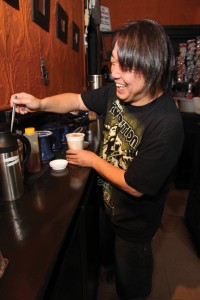
You know, I was playing with Henry Butler every Tuesday at Tipitina’s in the French Quarter and somebody asked for me one night: “Where y’at?” Henry Butler said, “He’s around the coffee shop on Magazine and Race.” Some Japanese people came ask for me, where am I? So he said, “You go down to coffee shop on Magazine and Race and you can meet him.” I always hanging here. I was living in that building over there, on the corner. I started my new life here in 1995. Nobody knew me then. I’d just moved here from Japan.
I saw that you were playing trombone on stage. Have you always played that?
I started playing trombone in middle school, and it just took off from there. In Louisiana, band is the thing to do. Everyone's a part of something in school, and a lot of us were in band. It was cool because we performed and marched.
It’s almost more fun to watch other fans watch slide-blues guitarist Landreth — a Breaux Bridge resident when he’s not on the road here in America and in Europe — than it is to watch Landreth.
As a mid-October Downtown Alive! attendee can attest, fans watch in wonder while Landreth plays his own version of glissando slide, in which he magically melds a Chet Atkins picking style with a Robert Johnson slide technique with, well, what seems like theremin-like hocus-pocus.
His between-the-notes technique leads to a “heavenly squall” of sonic beauty, as “Rolling Stone” magazine noted in the mid-1990s.
Revered during his day as a keyboard master (on piano and organ both) and a dude with a talent for living on the edge (over which he eventually plummeted), James Booker wove his way in and out of the fabric of New Orleans music from his early days in the 1950s through his untimely death in 1983 (he was only 44). Booker was not only gay at a time when that would have made his life difficult on a number of levels, but was also – sadly - an alcoholic and a junkie.
On a hot September afternoon, Anders Osborne faced a microphone -- and his transgressions -- in the piney woods of Bogalusa.
He had retreated to Studio in the Country to record a new batch of roots rock, blues and ballads, much of it autobiographical. The midtempo "Echoes of My Sins," spiked with swooping slide guitar, was especially telling.
Sonny Landreth’s From the Reach initially might seem as if it has joined the protest party rather late. Landreth has slowed down the pace of his recording projects over the past 15 years, and as a result, the endeavor is his first solo set since the disaster occurred. Fittingly, he wastes no time in addressing the concerns that have been weighing upon his mind. Blue Tarp Blues, the album’s opening track, is a biting indictment of a cultural climate that allowed Third-World conditions to invade American shores.
Mostly, however, Landreth uses From the Reach to delve into the fertile ground of relationships. He pours over the slow decay outlined in Storm of Worry. He burrows into the wistful reminiscence of When I Still Had You and revels in the lusty intoxication of Howling Moon. Although Katrina’s blowing winds, driving rain, and rampant devastation continually hover over the proceedings, the outing is doused in optimism as Landreth holds out hope that the future will be better than the present.
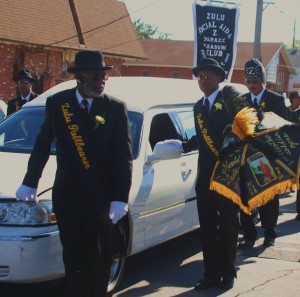
Harold Dudley was the Grand Marshal for the Zulu Social Aid and Pleasure Club from 1974 until his retirement 30 years later. His role, like that of all grand marshals in the city’s jazz funeral tradition, was to convey the emotions of the moment to the onlookers at the beginning and the end of the funeral procession. Dudley is in the pantheon of grand marshals because he was a master at representing the solemnity of the occasion. In his obituary he was called, the grand marshal of them all.”
The Preservation Hall band is now an intergenerational unit with young musicians such as Ben Jaffe on tuba, William Smith on trumpet and the Bingo! Show’s impresario Clint Maedgen on saxophone, joining traditional jazz icons like Maynard Chatters on trombone and Joe Lastie on drums.The lack of similar lifetimes didn’t matter one bit.They sounded great.Smith and Maedgen took vocal turns, as did Chatters.They brought out the powerhouse vocalist Thais Clark for a number and she brought down the house.Curiously, they ended their set with “When the Saints Go Marching In.”Perhaps the tourists, most of whom were unprepared for the drastic change in weather that greeted them when they exited the tent, were also unaware that a request for “The Saints” at the band’s headquarters on St. Peter Street in the French Quarter requires a significantly larger donation than any other song in the band’s vast repertoire.
His music — as heard on Thursday in Jazz at Lincoln Center’s Rose Theater, the first night of a three-night stand dedicated to his own work — makes life studies of people coexisting through history, in music, love, migration, families, church, slavery. Nearly every piece came with some kind of lesson, implicit or spoken, about judicious plurality. Mr. Marsalis locates lines and looks across them — lines of generation, culture, race and creed — then celebrates whatever he finds worth passing on to the next generation. His music, and his thinking, carry a blues optimism that things will work out by themselves. But he also wants to use his position to shape history, and his ambition to do so is out there on a stalk.
For the first time in his over 40-year musical career, Clyde Kerr Jr. steps up to release his debut album as leader. The renowned New Orleans trumpeter/flugelhorn player and educator immediately displays his great presence on the powerful opening, title cut, This Is Now! The tune bursts into the air artfully balancing jazz’s embrace of freedom with a sense of unity and structure.
“I wanted it to set the tone of the CD,” Kerr explains and adds that unlike most of his original pieces on the disc, this composition was newly penned. “I also wanted something for Kidd to stretch out on,” says Kerr referring to his longtime partner, saxophonist Edward “Kidd” Jordan. The trumpeter has worked with Jordan since the 1960s when they would play at house parties. The duo has also shared the front line of Jordan’s and drummer Alvin Fielder’s progressive Improvisational Arts Quintet since 1975.
Davy Mooney hails from the Crescent City, our kind of town, and attended the well-regarded music program over at the University of North Texas. Now he's up in NYC and like the other three plectrists in this piece, and is looking to stand out there. What stands out right away about Mooney is that he's not a six-string specialist...he plays a seven-string guitar instead. It gives him a little fuller and richer sound. But fear not, Mooney doesn't believe that more strings means cramming in more notes, he's too tasteful to fall into that trap. Mooney quickly follows up his guitar duo album with John Pizzarelli (Last Train Home (2009)) with Astoriano, a collection of nine originals and two covers. Mooney leads a cohesive base trio of himself, bassist Matt Clohesy and drummer Simon Lott, and adds in sax player John Ellis and organist Brian Coogan on select tracks. The songs all fall within the realm of post-bop with some light Brazilian touches here and there, but with interesting chord progressions and guys are given ample room to stretch. The arrangements are pretty good, too: John Coltrane's "Countdown" (evidently a popular cover amongst the LateSet crowd) is revitalized by a samba beat and some fantastic groovin' between Mooney and Clohesy. While the mood varies from song to song, Mooney and his crew maintains a strong sense of swing. With the fundamentals as a performer, composer and bandleader already down pat on Astoriano, the sky's the limit for Davy Mooney.
Earlier in the week, the Times-Picayune announced that the marquee lights of the Saenger would be relit for the first time since Katrina. Although for years now I had been been mourning the Saenger every time I went by it, thinking that nothing had been done since the Storm, it turns out, according to the article, that a consortium of developers (with experience restoring historic old theaters) have been toiling behind the scenes. The T-P reported that on Thursday, the public would be invited to see the long hallway into the theater, with displays of photos of the Saenger in the past and plans for its glorious future. I was SO excited!