Showing posts with label marva wright. Show all posts

Wednesday, March 24, 2010

New Orleans blues singer Marva Wright dies at 62

By Keith Spera, The Times-Picayune


marvarose

Marva Wright, the powerhouse New Orleans blues and gospel belter who left her job as a school secretary to sing around the world, died Tuesday of complications from a pair of strokes she suffered in 2009. She was 62.

Ms. Wright died at the eastern New Orleans home of her eldest daughter, where she had been living since her health declined last year.

Enormously popular among fellow musicians, Ms. Wright moved easily between gospel spirituals and bawdy blues romps. In her late-blooming career, she released albums on local and international record labels, and performed across Europe, in Russia and Brazil, and at blues festivals around the United States. She drew large crowds at the New Orleans Jazz and Heritage Festival presented by Shell, and staged an annual Christmas concert at Tipitina’s.

“She truly was and will remain the Blues Queen of New Orleans,” said Adam Shipley, Ms. Wright’s manager. “She was one of the highlights to ever grace the stage at Tipitina’s.”

Ms. Wright grew up in Carrollton. As a child, she listened to her mother sing and play piano at Greater St. Stephen Baptist Church on South Liberty Street. Her mother had attended McDonogh 24 Elementary School with future gospel legend Mahalia Jackson, and they remained friends.

“I met Mahalia when I was 9 years old,” Ms. Wright recalled several years ago, “but I never realized she was that popular until I got older.”

Ms. Wright graduated from Booker T. Washington High School, then left Southern University in Baton Rouge after two years to marry her first husband. While raising her children, she confined her singing to home and church.

As her children grew up, she worked as a secretary at Eleanor McMain Secondary School. Encouraged to pursue singing as a profession, she wrestled with the notion of performing sacred gospel music in secular clubs. She consulted childhood friend and fellow gospel singer Jo “Cool” Davis, who urged her to make the leap.

“You can only go so far in gospel,” Davis said. “People want to sing, they are inspired to sing. But not everybody has that raw, natural talent like Marva. I’d put Marva in a category with Mavis Staples. Somebody that talented has to go another route.”

She nurtured her early career in such Bourbon Street clubs as the Old Absinthe Bar.

“I love Bourbon Street,” she said in 2008. “If it wasn’t for Bourbon Street, I wouldn’t be where I’m at now. You meet a lot of people from all over the world.”

In 1990, while singing at Bourbon Street Gospel and Blues, she met “60 Minutes” correspondent Ed Bradley. He became an ardent fan; up until his death, Bradley introduced Ms. Wright for her Jazz Fest performances.

marva wright tab  benoit.jpg

Her tenth album, 2001’s “Marva,” was a typically eclectic affair, featuring such guests as Bo Dollis and Terrance Simien. She covered Bob Dylan’s “Serve Somebody” and “Knockin’ On Heaven’s Door.”

“To me, those are gospel,” Ms. Wright said at the time. “It’s new wave gospel, but it’s gospel.”

Of “Marva,” she surmised, “You can’t say it’s a gospel CD, you can’t say it’s a blues CD, you can’t say it’s an R&B CD, you can’t say it’s a country CD. You can say it’s all of it.”

In the 1990s, her audience at the Uptown club Muddy Waters occasionally included a daughter of then-Vice President Al Gore, and Gore’s wife, Tipper. That led to an invitation to perform at the White House.

Hurricane Katrina inundated her home in eastern New Orleans with nearly 8 feet of water. She and her second husband, Antoine “Tony” Plessy, moved to Bel Air, Md., near Plessy’s adult children. Ms. Wright was not impressed with the culinary sensibilities of her home-in-exile.

“I cooked gumbo without the essentials — our crabs and shrimp,” she recalled in 2008. “And they didn’t have hot sausage. Somebody sent me some crab boil seasoning; I used that. I’ll never forget, I cooked gumbo for Thanksgiving. I put in chicken and smoked sausage — I don’t do that here because I don’t need to.”

By the fall of 2006, she had resettled in Harvey. At that year’s Voodoo Music Experience in City Park, she performed a tribute to Mahalia Jackson in the Preservation Hall Tent. An overflow crowd showed up for her Sunday morning set, much to her surprise.

“The Saints are playing in the Superdome, and I’m not no Red Hot Chili Pepper,” she said, referring to another act. “All I am is little ol’ me.”

She had lost weight during her year in Maryland, but her clarion voice was undiminished. Backed by a crackerjack band, she sat on a stool, eyes clenched, and dug into gospel standards “This Little Light of Mine,” “Soon I’ll Be Done With the Troubles of This World” and “He’s Got the Whole World In His Hands.” She recast the Gloria Gaynor disco anthem “I Will Survive” as a dramatic statement of resolve.

From January 2007 through March 2008, Ms. Wright sang most weekends in the Ritz-Carlton’s On Trois Lounge. After leaving the Ritz — she apparently sang too loudly for the lounge — she returned to Bourbon Street with her band, the BMWs, an acronym for “Band of Marva Wright.”

In August 2008, Ms. Wright was among the Louisiana artists who performed at the delegates welcoming party of the Democratic National Convention in Denver. At the Colorado Convention Center, Ms. Wright sang “A Change Is Gonna Come,” accompanied by guitarist Tab Benoit.

In 2009, Ms. Wright suffered two strokes. She was first hospitalized in mid-May, then recovered sufficiently to resume performing. However, a far more traumatic stroke returned her to the hospital on June 6. In the difficult weeks and months that followed, she underwent dialysis treatments and struggled through rehabilitation. She never regained enough strength to perform.

Ms. Wright served as a de facto den mother to younger musicians. Indicative of her popularity, scores of performers appeared at an October benefit at Rock ‘n’ Bowl in her honor.

“Ms. Marva has always been so sweet,” benefit organizer Amanda Shaw said in October. “She’s been there for everybody, so we’re giving back.”

Survivors include her husband, Antoine Plessy; a son, James Kelly Jr.; three daughters, Jeanne Kelly, Elizabeth Gainey and Gerry McKey; 12 grandchildren; and three great-grandchildren.

Funeral arrangements are pending.

Friday, June 12, 2009

NolaFunk Lagniappe

Allen Toussaint's Keys To New Orleans

Web-Only Concert Pick: Allen Toussaint Performs 'Freedom For The Stallion'

Allen Toussaint (300)

Allen Toussaint keeps the New Orleans jazz-piano tradition alive in a concert from the Kennedy Center. New Orleans is not only the cradle of jazz. It's also the birthplace of great jazz piano, dating back to the early 1900s, when Jelly Roll Morton tickled the ivories. Hear three pianists who are keeping upholding that great tradition — Allen Toussaint, Henry Butler and Jon Cleary — onstage at the Kennedy Center in Washington, D.C., with Keys to New Orleans.


Marva Wright: Sharing the Joy of the Blues


Marva Wright’s boisterous vocals have established her as the clearly acknowledged “Blues Queen of New Orleans.” Marva started singing in the church at the age of nine, with her mother providing the accompaniment. Gospel legend Mahalia Jackson was a friend of the family, and Marva put her talents on display primarily for the congregation for decades. It was in church that she learned an early lesson with regard to her singing that she has carried throughout her career.
“When I played my first solo, ‘Just a Closer Walk with Thee,’ one of the deacons in the church was on the front bench,” she recalled. “He told me that I opened my mouth wide, but nothing was coming out of it. From that day, I vowed that I would always sing loudly.”


The Masterful Allen Toussaint & The Bright Mississippi


“Stately” is an adjective I rarely use to describe an album, but it fits Allen Toussaint’s new album, The Bright Mississippi, like a glove. The Bright Mississippi is a special album, demanding multiple listens to truly get the tapestry of American music – Ellington inspired jazz, r&b, Creole, ragtime – that it weaves with such effortless cool. It’s an album that contains the full experience that is life – its joys, sorrows, delights and hardships. That is to say, it's an album with soul.

Toussaint, of course, is an American Treasure; one of the masters of American R&B, a songwriter and producer who has worked with the likes of Dr. John, The Meters, Labelle, Elvis Costello, Solomon Burke, the Band and dozens of other greats. American R&B (and therefore, American music) is practically inconceivable without him.

This will be one of the best albums of the year – go out and get it. It’s not only that they don’t make albums like this anymore – it’s that no one before has ever made one quite like this.

see also: Allen Toussaint Set For Lincoln Center Out Of Doors 8/22


NY Daily News: Skirting the Treme: An insider's guide to New Orleans


Rampart Street, in some ways, is the fault line of New Orleans, separating the French Quarter, filled with well-heeled tourists and spring-breakers, from the Treme, a slightly more foreboding yet just as historic and memorable district.

Skirting the Treme, and further east the Seventh Ward, St. Roch and St. Claude neighborhoods, the adventurous visitor may experience the charm and flirt with the blithe unpredictability that permeates the real New Orleans that many tourists miss.


Community Tied By Strong Threads


The eclectic Threadhead roster features Continental Drifters alumnus Cowsill, jazz/pop/gospel singer John Boutté, singer/songwriters Paul Sanchez and Alex McMurray, genre-crossing trumpeter Shamarr Allen, jazz trombonist/vocalist Glen David Andrews, progressive brass band the New Orleans Nightcrawlers, trombonist Rick Trolsen, and bluesrocker Marc Stone. The company also recently published its first book, Pieces Of Me, collecting Sanchez's cathartically heart-wrenching, touching and funny blog entries about his rough yet rewarding journey back from the post-Hurricane Katrina trauma of losing his home and community.


Stew Called New Orleans”

Although I don’t listen to a whole lot of recorded music, when I find an album of music that I really like, I can get pretty obsessed, & right now I’ve found one that’s so good enough I have to write about it.
I should say the album “found me,” thanks to good blog friend Citizen K. who posted about it here—an excellent review that’s defintiely worth checking out— & then was kind enough to supply me with a copy. It’s called A Stew Called New Orleans (Threadhead Records), & it features the truly amazing vocals of John Boutté, along with vocals & rhythm guitar work by Paul Sanchez, trumpet by Leroy Jones, some exceptional electric guitar work by Todd Duke & bass by Peter Harris.


Michael Arnone's 20th Anniversary Crawfish Festival: New Orleans Comes to New Jersey


Each of the three stages had its own personality. The larger main stage hosted high energy acts that could play to the thousands who pulled up their lawn chairs to hear the powerful groups. A few of the ten bands on this stage included the High and Mighty Brass Band, with its Dirty Dozen/ Rebirth Brass Band stylings, and Papa Grow's Funk, which impressed the audience with its hard driving organ-fueled New Orleans sound. Day two featured Grammy-nominated blues guitarist Tab Benoit who drew thousands to stand and dance in the pit in front of the stage. The energy was palpable as Benoit moved across the stage playing flawless, high energy blues guitar.


BackTalk with James “Sugar Boy” Crawford

Whether you call it “Jock-A-Mo” or Chock-A-Mo” or “Iko-Iko,” it’s one of the greatest of all New Orleans Carnival songs. James “Sugar Boy” Crawford, who recorded the original version in 1953, rarely performs these days, preferring to bask in the glow of his incandescent grandson Davell. “The only place I sing is in church no,” Sugar Boy confesses.


“Jock-A-Mo,” one of a select handful of truly memorable Carnival songs, has had multiple personalities over the decades. Originally recorded in 1953 by James “Sugar Boy” Crawford, it was turned into an international hit over a decade later by a trio of New Orleans teenagers, the Dixie Cups, as “Iko Iko.” Since then, the song has been covered by Willie DeVille, Dr. John, the Neville Brothers, the Bell Stars [their version was in the Academy Award-winning movie Rain Man] and Cyndi Lauper, although none have approached the magnificence of Sugar Boy’s original.


Dr. John: Goin' Back to New Orleans

Albumcoverdrjohngoinbacktoneworleans

Rating: 98/100

Mac Rebennack, better known as Dr. John, is a walking, talking compendium of New Orleans music. As session cat, genial tickler of the ivories (organ keys and guitar strings too), gris-gris hoodoo-man, gargle-voiced blues shouter, worldwide rock star, and tireless proponent of all that's Easy—not to mention serious jazz pianist and master of Crescent City r&b—he has lived and largely defined the late 20th Century idea of New Orleans musician. His few solo piano albums are brilliant, and so too many of his slice-of-NOLA releases reinvigorating "funky butt" r&b. Still, in the end it's Mac at the piano that matters most as he takes the whole tradition into his hands every time he sits down at a keyboard.


Sister Gertrude Morgan

Sister Gertrude Morgan (1900-1980) was a preacher, missionary, artist, musician, and poet who worked in New Orleans in the 1960s and '70s, notable primarily for her folk art. She was born in 1900 in Lafayette, Alabama, and moved to Columbus, Georgia at the age of eighteen. She was married to Will Morgan in 1928, but at the age of 38 heard a voice from God telling her to become a street evangelist. She left her family and husband to move to New Orleans, where she organized an orphanage with two other missionaries. God told her to begin painting in 1956 and in 1957 heard a voice telling her that she was the Bride of Christ.


Christian Scott riding superlative horn wave


Like a lot of creative types, trumpeter Christian Scott is hard to stuff into a genre box. First, there's the clear sound of his horn, the one with the oddly angled bell. It's unmistakably part of a grand New Orleans tradition that reaches back to Louis Armstrong: a lone, expressive voice that projects its own personality as much as it does virtuosity. He could easily be playing gigs in the style of traditional New Orleans music or in the post- bop style practiced by another Crescent City hero, Wynton Marsalis.

But Scott prefers to push his trumpet up against walls of cinematic, rockish chords and instrumentation that reminds me more of the European trumpeter Michael Mantler than any of Scott's New Orleans brethren. Listening to his latest studio disc, "Anthem" or last year's "Live at Newport" set indicates that he absorbs a good deal of music and assimilates all of it into his own compositions and approach.


NOPV1 Reviewed by Alex Rawls in Offbeat Magazine!

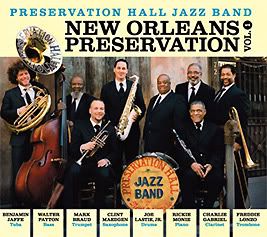
"By now, it can’t be a surprise that there’s a lot that is subtly smart about the Preservation Hall Jazz Band. Like the best traditional jazz, little of what’s special about New Orleans Preservation, Vol. 1 is obvious, but a little contemplation reveals a lot. For instance, it’s not until you get to Walter Payton’s faux-Armstrong vocal on “I Wish I Could Shimmy Like My Sister Kate” that you hear the sort of voice you expect on the album. Otherwise, Clint Maedgen and Mark Braud’s vocals suggest that traditional jazz isn’t just music for tourists and older generations. The inclusion of Jimmie Rodgers’ “Blue Yodel #9” and “Choko Mo Feel No Hey” (minus second line drums) says that traditional jazz is an approach to music, not a narrow library of antique texts. The inclusion of Maedgen’s original “Halloween” implies that the music can handle new songs as well. The pleasures of New Orleans Preservation, Vol. 1 aren’t solely conceptual. The ensemble playing is often wonderful, particularly in the ecstatic conclusion to “Tiger Rag,” where Braud’s trumpet and Charlie Gabriel’s clarinet keep threatening to break away from the band and each other, but never stray for good. On the Hall band’s first album since John Brunious’ passing, it also includes a second line of sorts for him, with “Westlawn Dirge” followed by a joyful “What a Friend” near the end of the album.

Saturday, November 8, 2008

Voodoo Fest Recap (via Jambase)

Words by: Saira Anderson | Images by: Zach Mahone

Voodoo Festival :: 10.24.08 - 10.26.08 :: New Orleans City Park :: New Orleans, LA

Voodoo Festival 2008 :: New Orleans
About 50 miles outside New Orleans, I switched the radio station to 90.7 FM, WWOZ, one of the world's greatest radio stations. The haunting brass and jazz sounds welcomed my ears to the Crescent City and a grin broke out on my face knowing what was about to happen. It was only Thursday but many people had already arrived to New Orleans, eager for the weekend's festivities to begin.

After settling in and before we headed to the first show of our visit, we went to a party on Decatur street. Kirk Joseph and his band were on the balcony of an apartment. Before long, Joseph was joined by Ivan Neville and the rest of the Dr. Claw guys, who were preparing for their gig at Tipitina's French Quarter. Their sweet sounds wafted below to the people on the street, who began to dance and shout after the end of each song. As Ivan jumped in on the keys, the tone of the weekend was set. What one must realize is that Voodoo Fest isn't contained in the boundaries of City Park, it spills out into the streets, onto the balconies, and it's this overall consumption of the city that makes seeing music in New Orleans such a special experience.

Friday, 10.24.08

The weather for the first day of Voodoo was perfect. As we approached City Park, we were greeted by the funky sounds and deep fried smells of a New Orleans festival. Our day could not have started off any better than by having Ms. Marva Wright's legendary voice greet us. Like many musicians from New Orleans, Wright isn't as well known outside the city as much as she once was. Her voice is not to be missed, and her stage presence captures your attention. Her set bounced back and forth from sweet soul songs to dirty, raunchy blues including her infamous "Ain't Got No Drawers On." Her song "Katrina Blues" reminded us all that New Orleans is still hurting and its struggle to rebuild must not be forgotten. "She ain't Koko and she ain't Etta, she's Marva Wright from right down here in New Orleans ya'll," and you best not forget that!


The next stop was the WWOZ Stage. Nashville soul fused with the local sounds in Big Sam's Funky Nation and the result was a delicious treat for the ears. The Dynamites featuring Charles Walker are a soulful force to be reckoned with, and by adding Big Sam to the bill they took their performance to a different level. They played a mixture of original and old soul tunes, each song forcing the audience members to move and smile. As long as bands like this keep playing, the world will be forced to remember the impact of the greats such as James Brown and Otis Redding.

For a complete change of pace, I headed to one of the bigger stages to see Wyclef Jean. After an almost twenty minute intro by his DJ, who did a good job pumping the crowd up, Wyclef took the stage and the crowd erupted, eager to hear his messages of peace and change. His set was very politically charged and the audience loved it. New Orleans wants to hear a motivated speaker remind them of where they want to go in the future, and Wyclef did just that. He played most of his standards and covers, including "No Woman, No Cry." All in all, I wasn't blown away. I can appreciate his performance, but musically he sounded almost over-rehearsed and stiff. This changed for a moment at the end of the set when Wyclef was joined by his former drummer, Adam Deitch. Deitch's sound is unmistakable no matter what genre or who he is playing with. Wyclef's face couldn't hide his excitement, and he threw himself into "Carnival," a fitting song for an event like Voodoo.

I had the privilege of speaking with Grace Potter earlier in the day and I'm happy to confirm the rumors that she is not only a wonderful person onstage but off as well. She's very real and down to earth, but at the same time very focused and demanding of the respect any great musician deserves. Potter's sister lived in New Orleans so she was well versed in the city and its impact on the musical world. In particular, she mentioned two of her biggest influences, Marva Wright and Dr. John. This is another great example of how special an event like Voodoo Fest is. People like Potter can find themselves playing at the same festival as someone they've admired for years, making the circle of music complete. Potter remarked that the people that live in and visit New Orleans know good music, and she feels like she and her band definitely have made a place for themselves in this vibrant musical culture. And part of being involved in this culture includes understanding the angst and anger of Katrina. "No one can snap their fingers and make it go away" said Potter, as she related how she was inspired to write a song that captures those feelings entitled "Ain't No Time." Her show at Voodoo was deep and dark, and despite technical difficulties, Potter stamped her gritty, sexy rock & roll performance in the minds of anyone who had the good fortune to see her.


As nighttime fell on the first day, I found myself completely taken with the image before me. The stage lights danced across Erykah Badu's wild hair, which perfectly complimented her regal outfit - her very essence captured me before a single sound came out of her mouth. Her beauty and greatness were amplified through her voice and her messages. As I watched her move across the stage, each step more deliberate than the last, I felt truly honored to be witnessing her performance. Her band never missed a note, and the execution of each song was beyond perfect. This performance accompanied by Badu's rhythmical, poetic voice, which hypnotized the crowd to such an extent that even the simplest of hand motions sent the audience into a frenzy. Badu was everything I had ever imagined her to be and her set combined the flavors of Africa with hip-hop and soul, creating a true musical feast for the city of New Orleans.

I had no idea what to expect when I approached the stage where TV On The Radio was playing. I'm still not sure I can describe exactly what I saw there. They sounded like a very experimental, psychedelic rock band. The music was overwhelming and I even though it wasn't the kind of show I would normally enjoy, but I couldn't help but be intrigued by their energetic, passionate delivery. There's something that I admire about bands that dig the shit out of themselves, and these guys totally do just that. Tunde Adebimpe, the lead singer, never stopped moving, constantly engaging the crowd, making me forget that the song content wasn't easily discernible. As far as the band went, the drummer's performance stood out the most. The collision of his sticks with the kit gave driving force to almost every song. These guys were super loud and very out there in many ways, making me feel like I need to see them again before I can really claim to have wrapped my head around this one.

Continue reading for Saturday's coverage...

Saturday, 10.25.08

Eric Krasno - Blue Nile
I was a bit tardy getting to City Park on Saturday because I was out late bouncing between the Blue Nile and Tipitina's. The Blue Nile was hosting an interesting side project that consisted of Adam Deitch on drums, Eric Krasno on guitar, Marco Benevento on keys and Kirk Joseph on sousaphone. There wasn't much time for rehearsal and as a result the show was very difficult to follow at times. A little ways into their first set, some random guy got onstage and started freestyling and sounded just awful. After two songs with him up there, I made the decision to try something new. That's the beauty of New Orleans: there is always something else going on. I headed to Tipitina's Uptown for another thrown together project that included a mesh of traditional New Orleans artists with Fred Wesley as their special guest. It was another failed combination in my opinion. The songs were very low energy and drawn out, and no one really seemed to be playing together. I was back in the car before long and glad to hear the energetic sounds of Big Sam's Funky Nation consuming the Blue Nile section of Decatur Street. Sam's new drummer, who came up in the church scene, stole the show along with an unknown musician on saxophone sitting in. Sam's band has really progressed in the last few months and they sounded great all the way around. Finally some sounds that could justify me staying up until five in the morning!

The first show I made it to at Voodoo on Saturday was Manchester Orchestra. The opening number had little impact on me and they didn't seem like it was going to get much better. They were a five-piece band that seemed lost, like they still hadn't found their sound. You could hear all the bands that might have influenced them, especially in the dark delivery of their vocals. All it took was a few boring songs and a glance at the seemingly unenthusiastic crowd and I was on my way. These guys may have that one song in the repertoire that could have grabbed me but unfortunately I didn't think it was worth waiting around to hear it.

Back on the WWOZ Stage, the Old 97's were tuning up. They seemed to have a decent following and the crowd at this particular point in the afternoon really latched onto their sound. They came off as straight forward, feel good rock & roll and I loved it. Perhaps I was taken by the lead singer, or maybe it was the very simple song content, which was easy to understand and relate to. Although they've been around for a while, I finally put these guys on my radar and look forward to digging in deeper.


Lil Wayne - Voodoo
Next it was time to follow the throngs of people headed to the main stage for Lil Wayne. He had a huge audience, one of the biggest of the weekend. But, even all those people couldn't convince me that what I saw on that stage was worth listening to. I was appalled, bored and totally embarrassed to be at this show. The man really has no talent and his only saving grace was that he made the effort to hire a mediocre live backing band. In my opinion, having a live band is a step in the right direction for hip-hop shows in general. Lil Wayne's style of word delivery was very choppy, and for someone who wasn't already a huge fan most of the songs seemed very similar. The dancing and hand gesture antics that accompanied his performance didn't distract me enough from the poor quality of the rest of the show.

Thievery Corporation was next. They were one of the main reasons I made an effort to come down to New Orleans for Voodoo Fest, and I was not disappointed. It's difficult to describe the greatness and production of this band until you see it first hand. The show began with the two masterminds behind it all - Rob Garza and Eric Hilton - setting the tone for through their DJing. Shortly thereafter, they were joined by a beautiful belly dancer, whose vibrant sensuality completed Thievery's takeover of Voodoo. The beauty of Thievery Corp is the way their setlist seems to perfectly evolve in the moment. Each member plays an equally crucial role, whether they are dancing, singing or playing. Thievery took all who saw them into a mesmerizing world of beautiful female vocalists and multiple male singers of all genres. Thievery Corporation always impresses with their ability to pick up on the energy of the crowd and respond to that with their performance. This time was no exception and halfway through a particular song one of the female vocalists jumped offstage and took her act into the crowd. The fans went wild, and as the sun began to set, Thievery led us all into the night and left us wanting more.

It took me a few moments to switch gears as I headed back to the WWOZ Stage for yet another band that New Orleans gave birth to. Led by Ivan Neville, Dumpstaphunk is making a stamp on the world of modern funk bands. There is no party like a Dumpstaphunk party and this set proved that point, where they were especially tight. The stage communication, transitions from song to song and setlist choices were almost flawless. Marc Broussard and Eric Krasno sat in on Dumpstaphunk original, "Unfunky U.F.O." The whole spirit of New Orleans cultivates such moments, where a pop artist and a guitar player from New York can find themselves on the same stage as a dirty, raunchy funk band from New Orleans. Dumpstaphunk songs bring the beauty and heart of New Orleans and the tragedy of Katrina to the rest of the world, while at the same time keeping the crowd moving from start to finish. This night, they were on fire, bringing the hometown crew an exciting mix of old and new material. The lyrics to "Meanwhile" echoed into the night, reminding us that even though Katrina left a mark, we might as well have a good time and shake our booty.


Marc Broussard was next on the WWOZ Stage, and after his performance with Dumpstaphunk I was hopeful that I might enjoy his set more than I had in previous years. However, I couldn't switch to Broussard's mainstream songs and performance. I do have to say that the man is truly talented and even if I don't exactly love his work, his delivery is magnificent.

I was excited to head over to Ghostland Observatory, a band I seem to keep missing at festivals. They were in full force when I arrived. It took me a while to focus on what was happening onstage because I was so distracted by the insanity and complexity of their light show. When I finally did focus in I was startled, shocked and not very impressed. The lead singer seemed to be a Mick Jagger-meets-psychedelic-madness type of thing, but not in a good way. The overall sound didn't seem very musical, more like controlled noise. I stayed for a few songs, mesmerized by the power these guys seemed to have over their audience and trying to figure out what I was missing. Perhaps I am just too old fashioned, in the sense that I want songs and people mastering their instruments onstage.

Saturday night was spent bouncing back and forth once again between Tipitina's and the Blue Nile. Tip's finally hosted the perfect combination of musicians including George Porter Jr., Russell Batiste, Ivan and Ian Neville and Fred Wesley Jr. They sounded phenomenal. Even though the set mainly consisted of old soul and funk covers, every song sounded fresh and exciting, proving once again the high caliber of musicianship onstage. I kept trying to leave Tipitina's but I couldn't. All the musicians seemed to really be enjoying playing with one another and none of their songs sounded old or tired, which happens sometimes when musicians play songs they have played hundreds of times.

The moment the last note was played I headed to the Blue Nile to give the Deitch, Krasno, Benevento, Joseph project another chance. I was pleased to see that they were about to begin their second set. To try and put into words what I heard is almost impossible. Krasno's tasteful notes gently guided the space-like jazz jam. Deitch and his usual drum-machine precision controlled the step of everyone in the room. Kirk Joseph finally started to grasp the direction these New York boys were headed musically and added to the sound with his psychedelic sousaphone. Benevento's inhuman hands danced across the piano and the result were wonderful and something none of us had quite heard nor will likely ever hear again. The sounds they made flirted with almost every genre. It was almost 6 a.m. before it was all over and I headed back to finally get some sleep.


Sunday, 10.26.08

Trombone Shorty - Voodoo
A quick cup of coffee and I was on my way back to the festival for the final day. I received lots of curious looks as I literally ran from the Voodoo Fest entrance to the WWOZ Stage. I didn't want to miss one note of Chali 2na reunited with Ozomatli. Ozomatli's infectious dance grooves have never let me down and it was great to see Chali grinning as he waited onstage for his turn to tear it up. He, of course, did not disappoint. The crowd erupted when Chali took the stage and I am happy to say that he sounded awesome. He is one of the smoothest performers, and he can control the motion of a crowd with a single hand movement and a smile. There were a few times that I noticed the timing between Chali and the band was off. It was easy to look past though, and didn't really detract from the set. Everyone onstage seemed as happy as the audience, and Ozomatli ended the show proclaiming their love for the city and all she stands for with their own rendition of the classic "Let the Good Times Roll."

Sharon Jones and the Dap-Kings were the next highlight of the day. The Dap-Kings are incredible and I love the way they pay homage to the old soul and funk entertainers by starting the show off without the lead singer, almost as if to get the audience warmed up. Jones has perfected her stage performance and as I watched her, images of long lost legends danced through my head. I smiled the entire duration of her show. Everyone else seemed to be feeling the same thing, especially the young man Sharon called onstage to serenade and the group of girls that she later invited up to dance with her. Jones' set ended all too soon, and we were all left staring at the stage as the classy Dap-Kings bid us all farewell.

Once again before I knew it, darkness fell on Voodoo Fest. Our nighttime entertainment was led by a young man who is definitely one of the driving forces in modern-day New Orleans: Trombone Shorty and his band Orleans Ave. With a potent blend of jazz, dance, hip-hop, funk and whatever else NOLA can ooze out, this man knows what he wants out of the music world and he knows how to work a crowd. Musically, he puts on a great show. Lyrically though, he doesn't always impress. Maybe it's because I want him to just play his horn (which he does so well) and not sing crossover pop songs. All of a sudden in the middle of his set, Shorty announced that ever infamous rapper Juvenile would be joining him. It was a very interesting moment but once again a representation of the music of New Orleans, which feeds off all the vibes of the city. The two songs he did were better than I would have imagined but not necessarily something I would want to hear again. Any rapper sounds better with a live band, especially one from New Orleans! I left before it was over to see one of the big headliners of the weekend.

Like anyone with a radio, I heard lots of R.E.M. growing up and the songs lodged themselves in my brain. However, even knowing the songs didn't cover up the fact that the overall energy of the band was sedated. They definitely tried to put their hearts into it but it just didn't work out too well. Most of the audience around me seemed very disengaged and somewhat let down. But you don't come to NOLA for big name radio stars, you come for the local heroes, the random sit-ins, the legendary late nights, the food, the people, the city itself. And rest assured, the glory of the Big Easy is burning bright, just waiting for you to come visit in a few months for Jazz Fest.




Sunday, March 23, 2008

NolaFunk Lagniappe

Chris Rose: A blessed night with the Mardi Gras Indians

"Whose idea was this? Nobody knows. Nobody cares. Nothing makes sense here. And that's probably why I like it. And that was all I could think about when I realized that Wednesday was St. Joseph's Day and that meant the Mardi Gras Indians were going to come out into the streets and I grabbed a jacket and a go-cup and went out to find them."


Kevin O'Day's Official Bio, written by Jay Mazza


"In a town filled with great drummers and renowned across the globe for percussive innovation beginning with the great trad jazz drummer Warren "Baby" Dodds, O'Day stands out as the go-to guy for gigs of any variety. He is regarded among his peers as a drummer's drummer with a passion that never wanes and a sympathetic ear that defines musical telepathy."


"You Know You Want It": Home of the Groove spotlights Chocolate Milk


"If you heard this group without knowing anything about them, you likely would not immediately suspect that Professor Longhair, Smokey Johnson, or Allen Toussaint, to shorten severely a long list of local influencers, were lurking in their collective woodshed, and, in the latter’s case, in the control room. Once I figured that one out, I started to dig them for what they had to offer rather than what my expectations were."


WWOZ wins honorable mention Esky Award for Best Internet Radio

WWOZ.org is listener-supported, volunteer-operated, Katrina-resilient miracle of FM radio that plays funk, jazz, blues, roots, Latin, soul, zydeco, R&B, and everything in between.


Trumpeter to Help New Orleans Libraries

"Mayfield said it's important to look at what has gone right since the storm. For one, at almost any school in the city _ no matter how dilapidated _ the students are playing music, he said. He says music is still in every part of the city, from the clubs, to the streets to the universities, and there's no reason why it shouldn't be part of the city's library system."


See also: Jazz trumpeter leads New Orleans' cultural rebirth

Jambase reviews "Funky Kidz"


"Not since Garcia and Grisman's Not for Kids Only (1993) has there been a kids collection likes this. Funky Kidz is a project that manages to capture a spirit that most children's music is sorely lacking – genuine funk."

SAMPLE THE FULL ALBUM HERE
.


Marva Wright on turning 60 and more


When was the last time you worked on Bourbon Street?

At Storyville the Friday night before Hurricane Katrina.

What a way to end it.

Ain't that something?

Would you go back to Bourbon Street?

Surviving is surviving. But you know what? I love Bourbon Street. If it wasn't for Bourbon Street, I wouldn't be where I'm at now. You meet a lot of people from all over the world. After Katrina, they were good to the musicians of New Orleans, everywhere we went.